
The UK online gambling sector generates 7.8 billion pounds in Gross Gambling Yield, and somewhere within that enormous figure sits a market model that most recreational punters have heard of but few truly understand. I started using Betfair Exchange in 2014, and it took me a solid six months to grasp why it was not just another bookmaker. The exchange is a fundamentally different mechanism: you are not betting against a bookmaker’s margin — you are betting against other punters, and that distinction changes the odds, the strategy, and the potential returns in ways that matter for anyone serious about horse racing.
Back and Lay Execution: Securing Value Outside Traditional Books
The moment that changed my understanding of the exchange was the first time I laid a horse. I had always been a backer — pick a horse, put money on it, hope it wins. But on the exchange, you can also be the bookmaker. You can offer odds to someone else, and if the horse loses, you keep their stake. That dual functionality — backing and laying — is what makes the exchange unique.
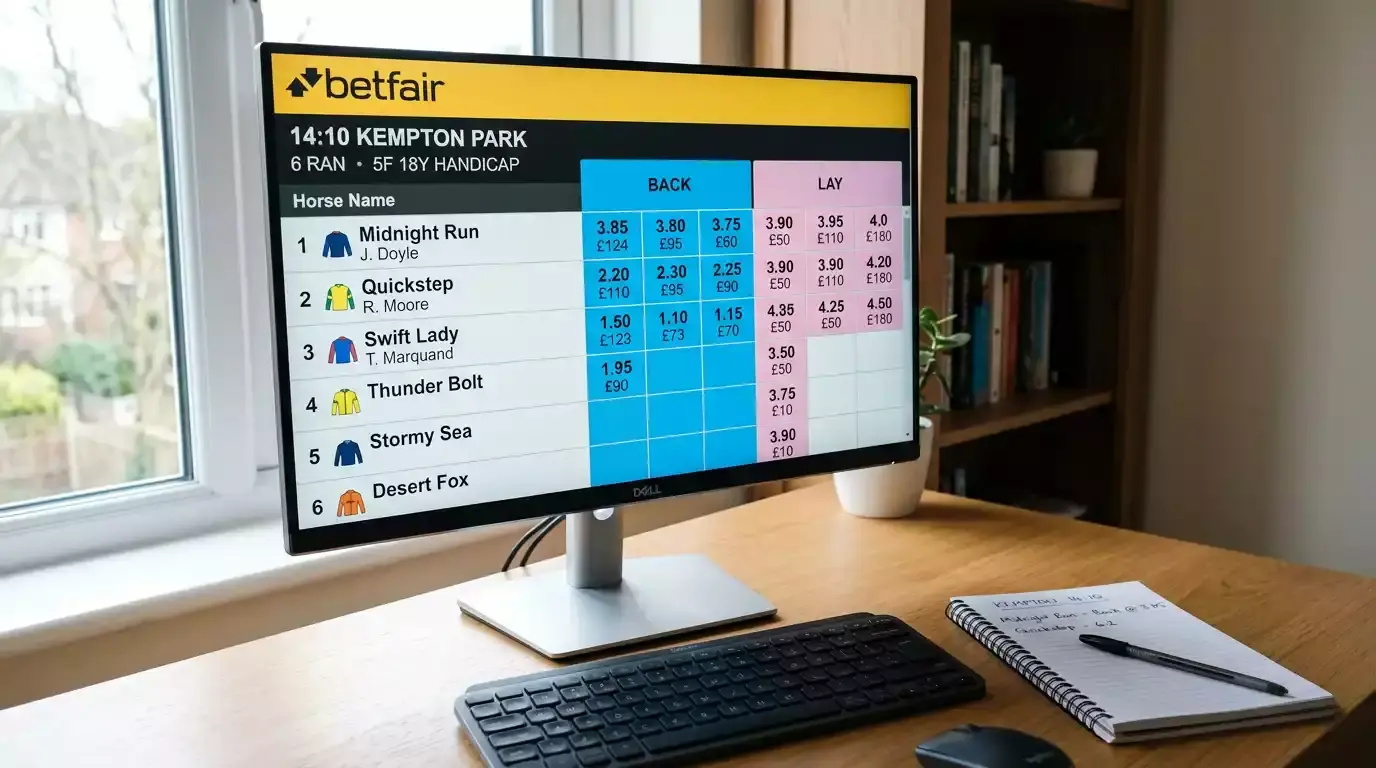
A back bet on the exchange works the same way as a bet with a traditional bookmaker: you stake money at a given price, and if the horse wins, you receive your winnings minus Betfair’s commission. A lay bet is the opposite: you are offering to pay out if the horse wins, in exchange for keeping the backer’s stake if it loses. Your liability on a lay bet is the amount you would have to pay if the horse wins, calculated as the lay odds minus one, multiplied by the backer’s stake.
Here is a worked example. Suppose a horse is trading at 5.0 on the exchange — that is 4/1 in fractional odds. If you back it with a 10-pound stake and it wins, you receive 40 pounds profit minus commission. If you lay it with someone else’s 10-pound stake and it loses, you keep their 10 pounds minus commission. If it wins, you pay out 40 pounds. The risk-reward profile of laying is the mirror image of backing, and understanding when to use each side is the core skill of exchange betting.
In-play trading takes this further. You can back a horse before the race and lay it during the race if its price shortens, locking in a profit regardless of the outcome. This is how professional exchange users operate: they trade positions rather than simply betting on outcomes. It requires fast execution and a reliable connection — one reason why exchange betting on mobile is growing alongside the 43% of all UK betting that now happens on phones — but the principle is accessible to anyone willing to learn.
Commission Structure vs Bookmaker Overround
I ran the numbers once on a typical 8-runner handicap hurdle, comparing the overround at three high-street bookmakers with the equivalent exchange market. The bookmakers’ overround ranged from 115% to 122%. The exchange market, expressed in the same terms, was 101.5%. That gap — between a 15-22% house edge and a 1.5% house edge — is the single most important number in this article.
Betfair charges commission on net winnings, currently at a base rate of 5% for most users, with reductions available based on volume. On a 10-pound back bet at 5.0 that wins, your gross profit is 40 pounds, and the commission is 2 pounds, leaving a net profit of 38 pounds. At a traditional bookmaker offering 4/1 with no commission, the payout is 40 pounds — but the bookmaker’s odds already include a margin that means the true probability implied by the price is higher than the odds suggest.
Over the long term, the exchange’s lower margin translates into better value for punters who bet regularly. Horse racing remote betting in the UK generates 766.7 million pounds in GGY, and the exchange’s share of that market has grown steadily as punters recognise the structural advantage of peer-to-peer odds formation. For a punter placing 50 bets a month, the cumulative difference between exchange odds and bookmaker odds can amount to several percentage points of return on turnover — a meaningful edge.
The trade-off is simplicity. A traditional bookmaker offers a single price, a clean interface, and no need to understand matching or liquidity. The exchange requires you to navigate a depth-of-market display, understand the difference between matched and unmatched bets, and accept that your desired price may not be available if the other side of the market is thin.
Liquidity Patterns: When Exchange Markets Are Deep Enough to Use
I learned the liquidity lesson the hard way when I tried to back a horse in a Monday afternoon handicap at Plumpton. The exchange market had 12 pounds matched on the entire race. My 50-pound stake sat unmatched until ten minutes before the off, when a layer finally took the other side — at worse odds than I had asked for. The race was run and won before I had placed the bet I wanted.
Liquidity is the exchange’s weakness on minor fixtures and its strength on major ones. Feature races at Cheltenham, Ascot, Newmarket and Aintree attract deep markets with hundreds of thousands of pounds matched. You can back or lay at tight spreads, trade in-play with minimal slippage, and execute strategies that are impossible in thin markets. Midweek fixtures at smaller tracks — Sedgefield, Fontwell, Fakenham — often lack the liquidity to support meaningful exchange betting.
The pattern is predictable: liquidity builds in the hour before the off, peaks in the final five minutes, and spikes again during the race if in-play trading is active. For most punters, the practical approach is to use the exchange for feature races and televised fixtures, and to use traditional bookmakers for the rest. This hybrid strategy captures the exchange’s better odds on the races where it matters most while avoiding the frustration of thin markets on quiet cards.
One additional note: exchange liquidity is influenced by the same demographic shifts affecting the wider market. As more punters move to mobile and the casual fan base grows around festival periods, exchange volumes at peak meetings are actually increasing even as the broader betting market contracts. The exchange market is becoming more concentrated around fewer, bigger events — a pattern I expect to continue.