
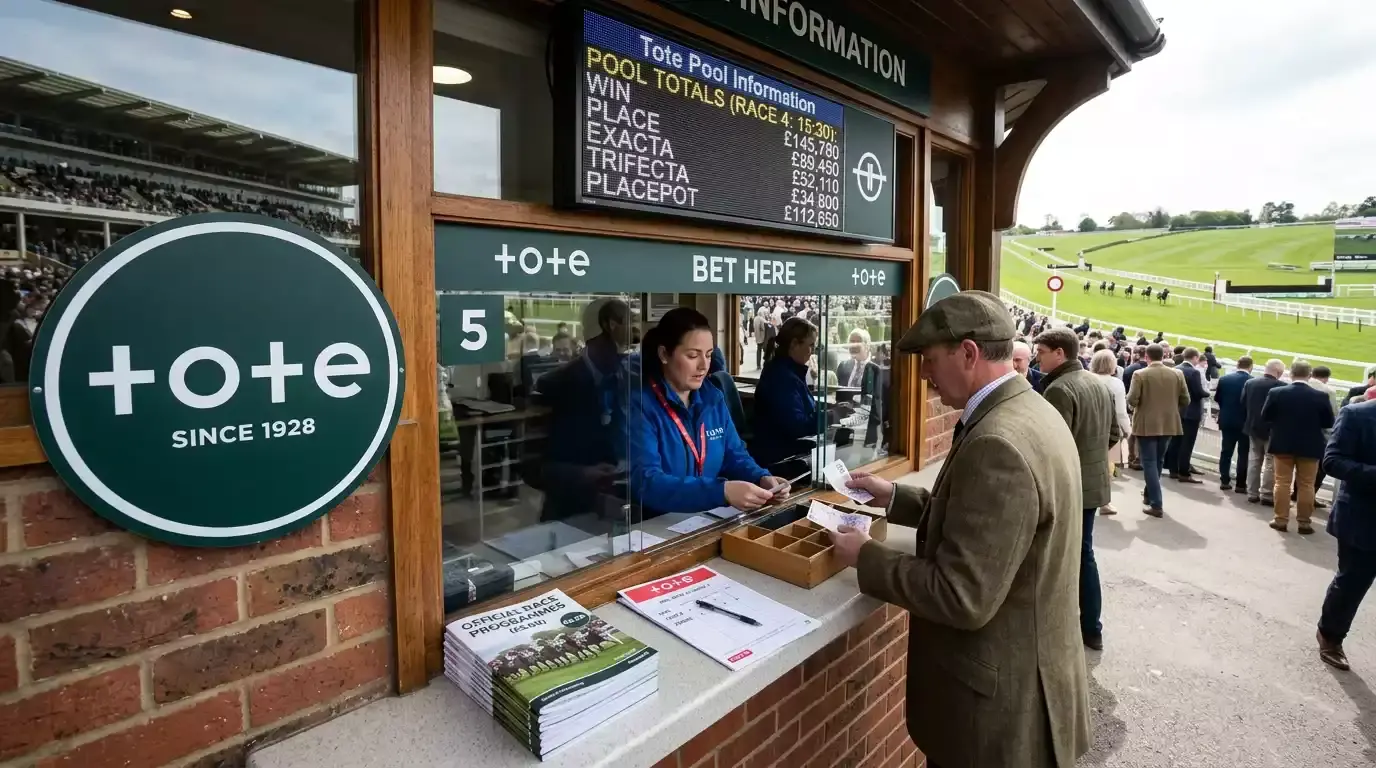
There is a betting window at every British racecourse that most punters walk past without a second glance — the Tote. With 5.031 million people attending racecourses in 2025, the highest figure since 2019, you would think more of them would discover what pool betting offers. Yet the Tote remains one of the least understood parts of the horse racing betting landscape, and that lack of understanding is precisely what creates opportunities for those who take the time to learn how it works.
Dividend Calculations: Assessing Value in Pari-Mutuel Pools
I placed my first Tote bet on a whim at Kempton one evening, not understanding the difference between a pool dividend and a fixed-odds payout. The horse won, I collected my dividend, and it was actually higher than the SP. That got my attention.
Pool betting operates on the pari-mutuel model. All stakes on a given market are pooled together, the operator takes a percentage deduction — typically between 13% and 27% depending on the bet type — and the remaining pool is divided among winning bettors in proportion to their stake. The dividend is not known until after the race, because it depends on how much money has been staked on each horse.
This is fundamentally different from fixed-odds betting, where you lock in your odds at the point of placing your bet. With the Tote, you are accepting an unknown price. The dividend could be higher or lower than the equivalent fixed odds, depending on where the pool money has gone. If the public has backed the winner heavily, the dividend will be lower than SP. If the winner is relatively unfancied in the pool, the dividend will be higher. In practice, outsiders tend to pay better on the Tote than with fixed-odds bookmakers, while short-priced favourites tend to pay worse.
The deduction percentage matters more than most punters realise. On a Win pool, the Tote takes roughly 13.5%. On an Exacta or Trifecta, the deduction can be 20% or more. That is the cost of entry, and it means that pool betting carries a higher baseline margin than the exchange but can still beat traditional bookmaker odds on specific outcomes — particularly at longer prices. The arithmetic favours selective use rather than blanket adoption.
Placepot, Jackpot and Scoop6: The Main Pool Bets
Paddy Desmond, Chief Revenue Officer at The Tote, has spoken candidly about the governance challenges facing British racing, and one of the areas where the Tote has carved out a genuine niche is in multi-race pool bets that have no direct equivalent in the fixed-odds market.
The Placepot is the most popular Tote bet and the one I use most frequently. You need to select a horse to place — first, second or third depending on field size — in each of the first six races on a card. A minimum stake of one pound buys you into the pool. If all six selections place, you receive a share of the total pool. The dividends can be significant: at major meetings, Placepot pools regularly exceed 500,000 pounds, and a winning one-pound line can return anywhere from 20 pounds to several hundred pounds depending on the difficulty of the results.
The tactical approach to the Placepot is to use bankers and perms. A banker is a horse you are confident will place, and a perm expands your coverage to multiple selections in the races where you are less certain. A two-pound perm covering two horses in three races and one horse in three races gives you eight lines for eight pounds. The cost scales quickly — three horses in all six races is 729 lines — so discipline in selecting your perms is essential. I typically use one or two bankers and limit myself to two selections in the remaining races, keeping the total outlay under 20 pounds per card.
The Jackpot requires you to pick the winner of the first six races — a harder task than the Placepot’s place requirement. Jackpot pools are smaller, but the dividends for a correct selection can be transformative. This is the high-risk, high-reward end of pool betting, and I treat it as a small-stakes lottery rather than a serious analytical exercise.
The Scoop6 runs on selected Saturdays, covering six nominated races across the day’s televised programme. It requires winners in all six races, and rollovers can push the pool into six figures. The bonus fund, available to the previous week’s Scoop6 winners if they can nominate the winner of a specified race, adds an additional layer. The Scoop6 is the closest thing pool betting offers to a progressive jackpot, and while the odds of landing it are long, the structure makes it a fascinating puzzle for punters who enjoy multi-race analysis.
When Pool Betting Offers Better Value Than Fixed Odds
I now run a simple check before every major race meeting: compare the likely Tote dividend on my selection with the fixed odds available at traditional bookmakers. The comparison is not always favourable to the Tote, but in specific situations pool betting offers genuine value.
Outsiders at big meetings are the primary opportunity. When the pool is swollen by casual money backing well-known names and short-priced favourites, the proportionate share of the pool for an unfancied winner grows. At the Grand National, Cheltenham Festival and Royal Ascot, where pool sizes spike with public interest, a winner at 20/1 SP might return a Tote dividend equivalent to 25/1 or more. The pool is larger, and the informed punter’s share of it is proportionately greater when the crowd money is elsewhere.
Favourites at quiet midweek meetings are the opposite scenario. On a Monday at Catterick with a small pool, backing the favourite through the Tote almost always pays less than the SP. The pool is thin, the favourite attracts a disproportionate share of the money, and the deduction percentage bites harder. I avoid Tote betting on low-profile cards entirely.
One structural advantage worth noting: the Tote does not restrict accounts or limit stakes in the way fixed-odds bookmakers increasingly do. A punter who has been restricted by a traditional bookmaker can still place pool bets at whatever level the pool will absorb. For high-volume bettors who have faced account restrictions, the Tote represents an unrestricted alternative — imperfect, because you cannot lock in a price, but accessible in a way the fixed-odds market may no longer be.