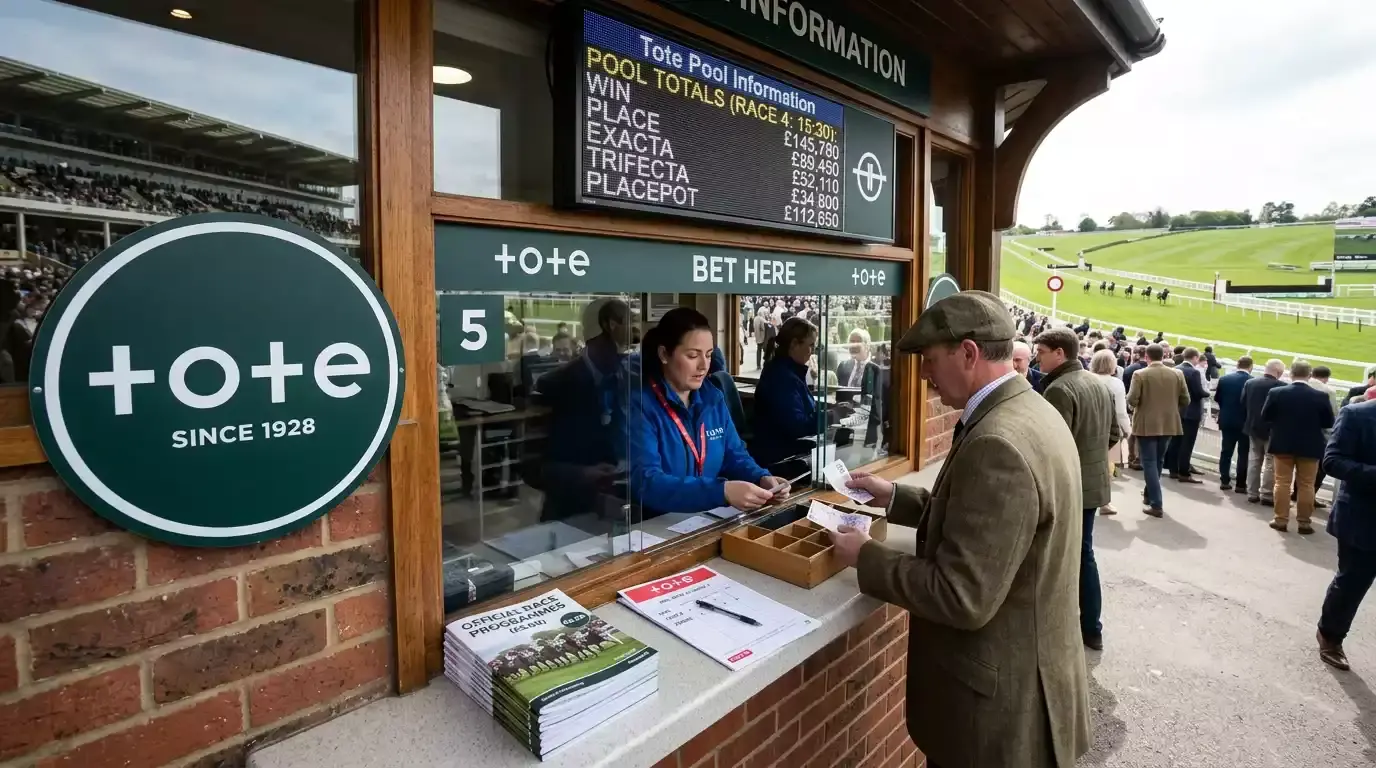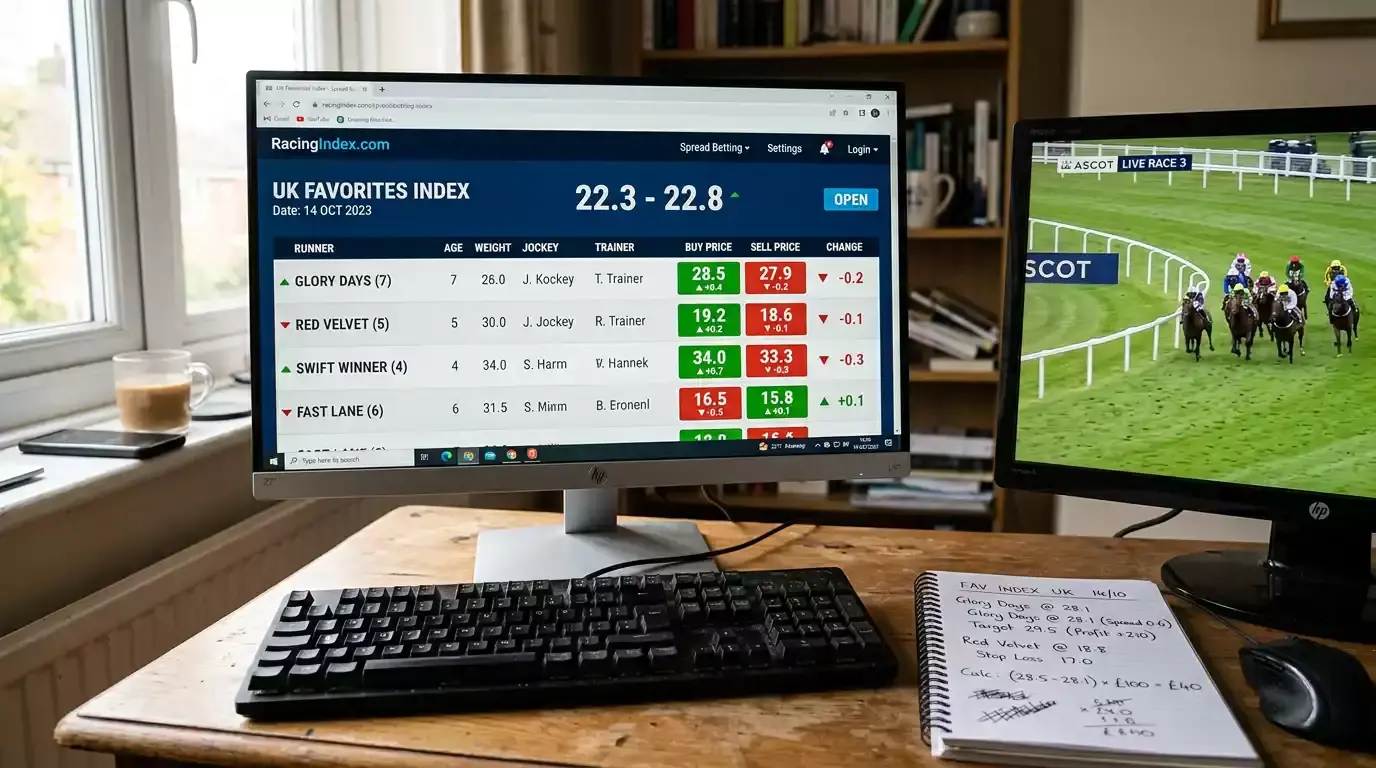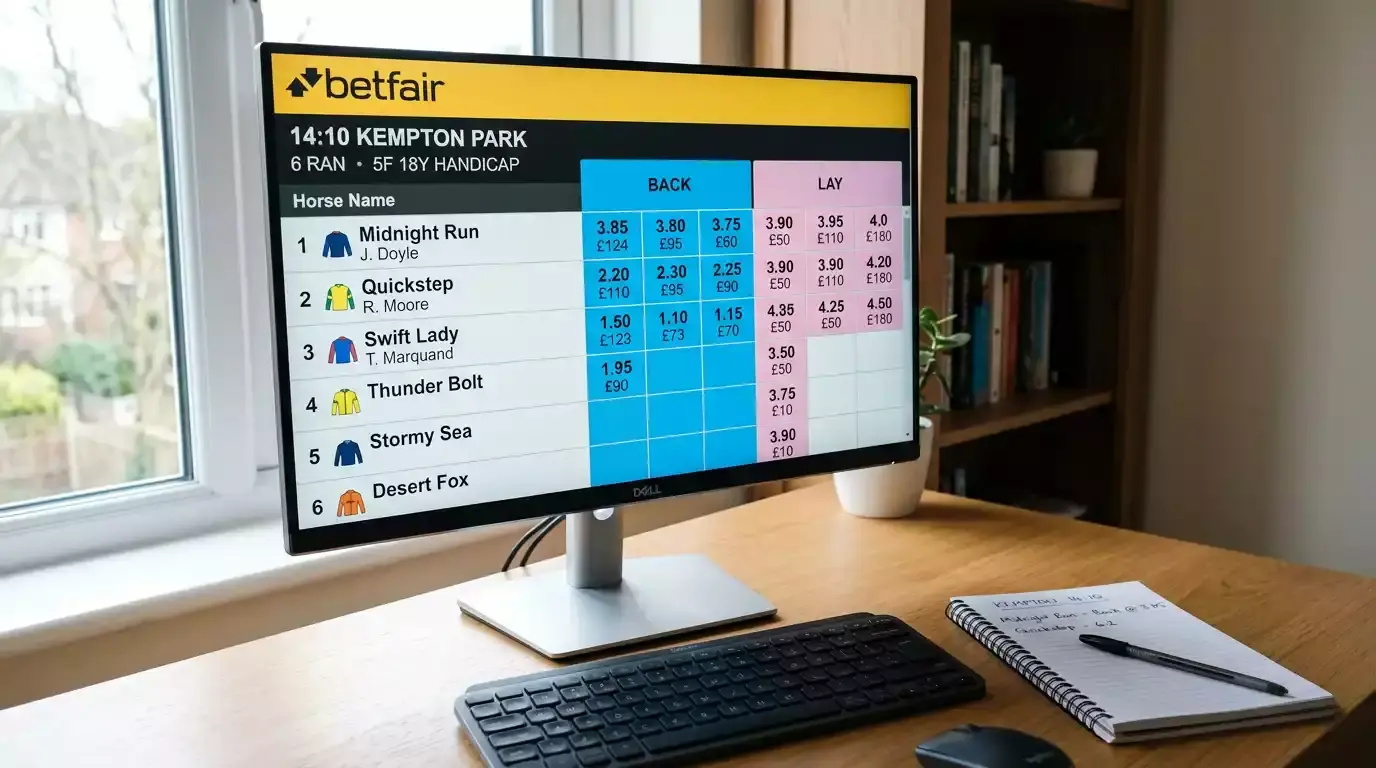

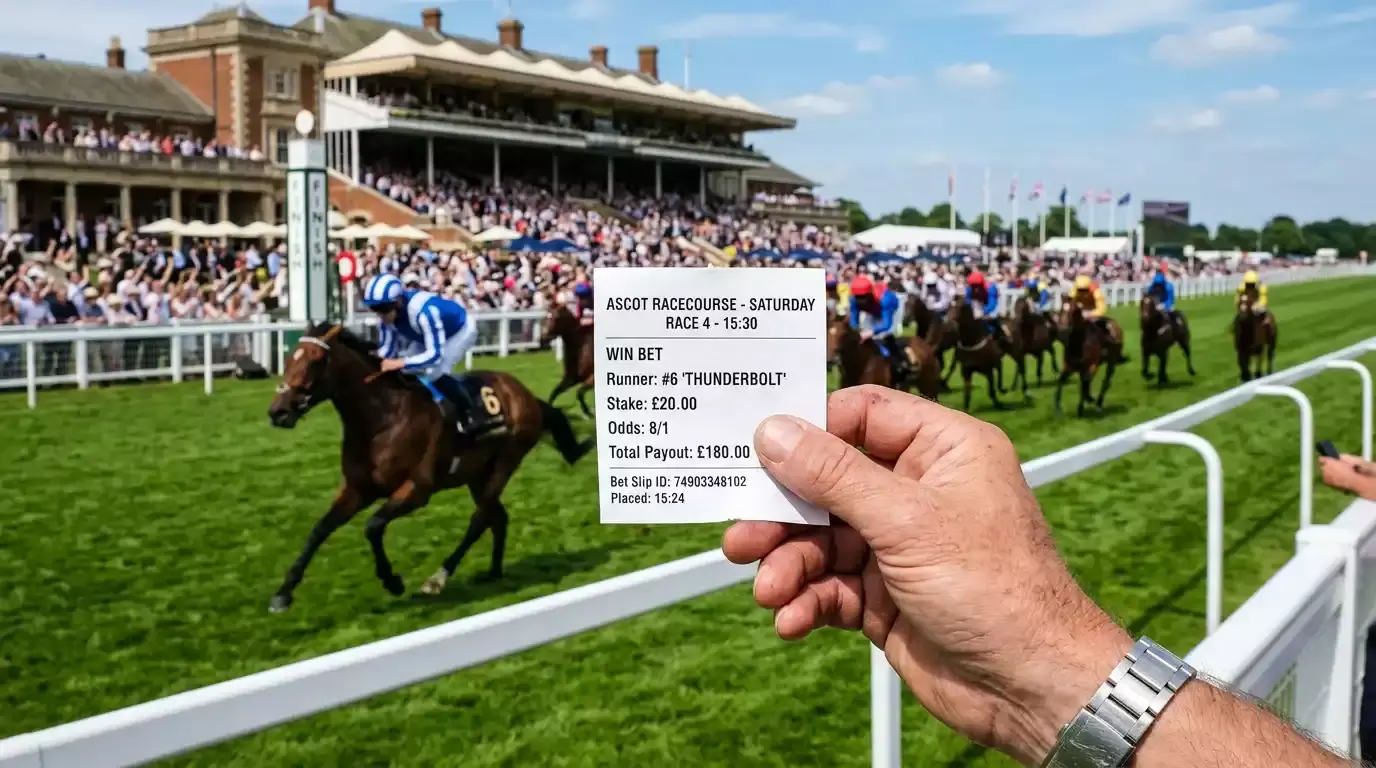
Horse racing bet types go well beyond picking a winner and hoping for the best – but you would not know that from watching most punters at the track. During the peak festival months, roughly 7% of British adults place a bet on the horses, and the overwhelming majority stick to straight win bets. There is nothing wrong with that. A win bet is clean, simple and honest. But limiting yourself to one bet type is like showing up to a restaurant and only ever ordering the soup.
I have spent years working through the full menu – each-way, forecasts, tricasts, accumulators, full-cover bets, ante-post markets – and each one has a specific situation where it outperforms the alternatives. The trick is knowing which tool fits which job. An each-way bet on a 20-runner handicap is a fundamentally different proposition from an each-way bet on a five-runner Group 1. A Lucky 15 makes strategic sense in contexts where four singles do not.
This piece walks through every major bet type available on UK horse racing, with worked payout examples and an honest assessment of when each one is worth your money. I am not going to pretend they are all equal. Some are elegant instruments; others are margin traps dressed up as excitement. I will tell you which is which.
If you want to cover multiple selections without risking your entire stake on a single accumulator, learning how a Lucky 15 wager works is an essential step.
Win and Place Markets: The Foundation of Racing Bets
A friend once asked me to explain horse racing betting in one sentence. I said: “Pick a horse, decide whether it needs to win or just finish near the front, and hand over your money.” That is the entire foundation – win bets and place bets – and everything else is an elaboration on these two ideas.
A win bet does exactly what it sounds like. You select a horse, choose your stake, and you get paid only if that horse finishes first. At 5/1, a £10 win bet returns £60 if the horse wins and nothing if it finishes second. There is no consolation prize, no partial payout, no grey area. The clarity is the appeal.
A place bet pays out if your horse finishes in the top positions, with the number of places depending on the field size and the type of race. In races with five to seven runners, bookmakers typically pay on the first two. With eight or more runners, the first three count as places. In large-field handicaps of 16 or more runners, four places are paid. Some bookmakers extend this to five or even six places on the biggest races as a promotional offer.
The place odds are a fraction of the win odds. If a horse is 8/1 to win and the place fraction is 1/4, the place odds are 2/1. I will break down these fractions in detail in the each-way section, but the principle is simple: you accept a lower payout in exchange for a broader target. Your horse does not need to be first – just close.
Win bets suit situations where you have a strong opinion about the most likely winner. Place bets suit situations where you believe a horse will be competitive but lack confidence in it actually winning – perhaps it is running in a strong field and you rate it for a top-three finish. Neither bet type is inherently better. They answer different questions about the same race.
Each-Way Betting: Place Terms, Fractions and Payout Scenarios
Each-way is the bet that causes more confusion than any other in racing, and I say that having explained it to probably a hundred people over the years. The confusion is understandable – it is actually two bets in one, and the payout depends on a set of rules that change based on the size of the field.
When you place a £10 each-way bet, you are placing two separate £10 bets: one on your horse to win and one on it to place. Your total outlay is £20, not £10. This catches beginners out constantly. The win part pays at the full advertised odds if the horse wins. The place part pays at a fraction of those odds if the horse finishes in a qualifying position.
The fraction depends on the number of runners and the race type. In non-handicap races with five to seven runners, bookmakers pay 1/4 of the odds on the first two places. With eight or more runners, it is still 1/4 odds but on three places. In handicap races with 12 to 15 runners, you get 1/4 odds on three places. In handicaps with 16 or more runners, the standard terms are 1/4 odds on four places. Some firms offer 1/5 odds rather than 1/4 on certain race types – these terms are worse for you, and worth checking before you bet.
Average field sizes on the Flat sit at 8.90 runners in 2025, down from 9.14 the previous year. Over jumps, the figure is 7.84, down from 8.49. These declining fields have a direct impact on each-way value. With smaller fields, fewer places are paid, and the each-way edge narrows. Where each-way really shines is in large-field handicaps – the big Saturday races with 16 or more runners, where four places and occasionally extra places from promotional offers create a wide safety net.
Let me work through a concrete example. You back a horse at 8/1, each-way, £10. Your total stake is £20. The place terms are 1/4 odds, three places. If the horse wins, you collect on both parts: £80 profit from the win bet (£10 at 8/1) plus £20 profit from the place bet (£10 at 2/1, which is 8/1 divided by 4), plus your two £10 stakes back. Total return: £120. If the horse finishes second or third but does not win, you lose the win bet (£10 gone) but collect on the place bet: £20 profit plus your £10 place stake. Total return: £30 on a £20 outlay, so £10 profit overall.
Now consider the same bet if the horse is 3/1 rather than 8/1. Each-way at £10 costs you £20 again. If the horse finishes third, the place bet pays at 3/4 – which is 3/1 divided by 4. That is less than evens. You get £7.50 profit plus your £10 place stake: £17.50 back on the place portion. But you have lost the £10 win stake, so your total return is £17.50 on a £20 outlay. You have actually lost £2.50 despite your horse placing. This is the each-way trap at short prices – the place fraction does not generate enough return to cover the losing win bet.
My rule of thumb: each-way betting starts to make strategic sense at odds of around 5/1 and above, in fields of eight or more runners. Below that, you are often better served by a straight win bet or a place-only bet if your bookmaker offers the market separately.
One more wrinkle: Rule 4 deductions. If a horse is withdrawn after the market has formed, Rule 4 applies a sliding-scale deduction to all winning bets in that race, based on the price of the withdrawn horse. On an each-way bet, the deduction applies to both the win and place portions. A late non-runner at short odds can cut your payout significantly, which is why monitoring declarations on race morning matters.
Forecast and Tricast: Predicting the Exact Finish
The first forecast bet I ever won was at Kempton on a Wednesday evening. I had two horses I liked and could not separate them, so instead of backing each to win I put them in a straight forecast – first and second in the exact order. They came home 1-2 at a combined payout I would never have achieved with two individual win bets. It was an education in what happens when you move beyond one-horse thinking.
A straight forecast requires you to predict the first and second in the correct order. A reverse forecast covers both permutations – your two selections finishing first and second in either order – but costs twice the stake because it is effectively two bets. The payouts on forecasts are calculated by the computer straight forecast, or CSF, which factors in the starting prices of all runners and produces a dividend after the race. You do not know the exact return before the off, which makes forecasts feel more like a lottery to some punters. I see it differently: the uncertainty in the price is what creates the value, because fixed-odds forecasts offered by bookmakers tend to carry wider margins than the CSF.
Tricasts take it further – you predict the first three in exact order. The computer tricast dividend reflects the difficulty of the task, and in open handicaps with large fields the payouts can be enormous. I have seen tricast dividends north of £2,000 to a £1 stake on a competitive Saturday handicap. The flip side is that hitting one is extremely difficult. You need to be right about three separate outcomes in sequence, and even the most accomplished form students will go months between tricast winners.
Where forecasts and tricasts earn their place is in small-field races where you have a strong view on the principals. A five-runner novice chase where you are confident about the first two but cannot pick between them for the win is an ideal reverse forecast scenario. The payout for getting both right in a small field is lower than in a big handicap, but the probability of success is materially higher. Tricasts work best in races of eight to twelve runners where form narrows the realistic contenders to five or six, but the race is open enough to generate a decent dividend.
A word of realism: if you are betting forecasts and tricasts regularly as your primary bet type, you are going to endure long losing runs. These are high-variance bets by design. They belong in a portfolio alongside more consistent bet types, deployed when the race conditions and your form analysis align.
Find the most competitive prices for your multiples and each-way bets by checking the daily updates on RailBet.
Accumulators and Multiple Bets: Risk, Reward and the Maths
Nothing in horse racing betting generates more excitement – and more quietly donated money – than the accumulator. I have placed my share of accas over the years, and the ones that came in are among my best memories in the sport. The ones that did not are the reason I now approach multiples with a calculator rather than a prayer.
An accumulator combines multiple selections into a single bet where the winnings from each selection roll over into the next. A double is two selections, a treble is three, a four-fold is four, and so on. Every selection must win for the bet to pay out. One loser and the entire stake is gone.
The appeal is compound returns. A four-fold at average odds of 4/1 per leg delivers a combined payout of 624/1 – put £2 on and you are looking at £1,250 back if all four win. That headline number is seductive. The maths behind it is less so. If each horse genuinely has a 20% chance of winning (which 4/1 implies), the probability of all four winning is 0.2 to the power of 4, which is 0.16%. You are looking at roughly a 1-in-625 chance of success.
Bookmakers love accumulators precisely because the overround – the margin built into each horse’s odds – compounds with every leg. If a bookmaker’s margin is 10% on a single race, a four-fold effectively multiplies that edge. The operator’s expected profit on a four-fold is substantially higher than on four individual singles, even though the potential payout is much larger. This is not a conspiracy; it is arithmetic. And it is the reason that every major bookmaker promotes accumulators heavily in their marketing.
Total betting turnover on British racing has dropped 10.3% since 2023, yet accumulators remain popular because they offer transformative payouts from small stakes. That popularity, however, does not make them a good strategy for most punters. Over a season of regular accumulator betting, the mathematics heavily favours the bookmaker.
Does that mean you should never place an accumulator? No. It means you should understand the trade-off. If you enjoy the entertainment value of a small-stake, high-reward bet and you treat the stake as the price of that entertainment, accas are fine. If you are trying to grow a bankroll systematically, singles and doubles are far more efficient vehicles. The variance on accumulators is simply too high to sustain consistent returns.
A practical middle ground: limit accumulators to doubles and trebles, where the overround compression is less punishing, and reserve four-fold-plus bets for small fun stakes you are genuinely comfortable losing. That boundary between discipline and enjoyment is where profitable punters live.
Full Cover Bets: Lucky 15, Yankee, Trixie, Patent and Goliath
Full-cover bets occupy the space between disciplined singles and high-variance accumulators, and they are – in my view – the most misunderstood category in horse racing. Most punters have heard of a Lucky 15 but could not tell you why it exists or when it outperforms the alternatives. Nevin Truesdale, the former Jockey Club chief executive, once argued that the regulatory direction seemed to push the industry toward small-stakes punters only – a concern I share. Full-cover bets are a middle-ground format that lets moderate-stakes bettors spread risk intelligently.
The principle behind every full-cover bet is that your selections are combined into every possible multiple combination, so you collect returns even if not all your picks win. Here is the family tree. A Trixie takes three selections and produces four bets: three doubles and one treble. A Patent is the same three selections but adds three singles, giving seven bets total. A Yankee uses four selections across 11 bets: six doubles, four trebles and one four-fold. A Lucky 15 is a Yankee plus four singles, making 15 bets. Then there are Lucky 31 (five selections, 31 bets), Lucky 63 (six selections, 63 bets), Heinz (six selections, 57 bets without singles) and Goliath (eight selections, 247 bets).
The key distinction is whether singles are included. Bets with singles in the name – Patent, Lucky 15, Lucky 31, Lucky 63 – give you a return even if only one selection wins. Bets without singles – Trixie, Yankee, Heinz, Goliath – require at least two winners before you see anything back.
Lucky 15 deserves special attention because most bookmakers attach bonus terms. The standard offer is a consolation payout if only one of your four selections wins – typically the return is doubled. If all four win, many firms add a 10% or 15% bonus to the total payout. These bonuses tilt the expected value in a direction that straight accumulators cannot match. A Lucky 15 at £1 per line costs £15 total. If two of your four selections win at decent odds, you are likely to recoup most or all of your stake from the doubles alone. If three or four win, the treble and four-fold deliver the explosive payout – plus the bonus.
Where full-cover bets go wrong is when punters treat them as a way to bet more races without increasing their bankroll discipline. A £2 Lucky 63 costs £126. A £5 Goliath costs £1,235. These are not small bets, and the total outlay can creep up quickly if you are not tracking it. I use full-cover bets selectively – typically a Lucky 15 once or twice a week on a strong Saturday card where I have four well-researched selections at 4/1 or longer. At shorter prices, the doubles and trebles in a full-cover bet generate modest returns and the mathematics become less compelling.
For a different approach to spreading risk across multiple runners, Dutching lets you back two or more horses in the same race for an equalised return – a useful complement to full-cover bets when your analysis identifies more than one realistic contender.
Ante-Post Bets and Festival Specials
The morning I placed my first ante-post bet – three months before the Cheltenham Festival – I felt like I was throwing money at a guess. The horse got injured six weeks later and I lost my stake with no refund, no void, no second chance. That was the education I needed. Ante-post betting is a different game, and it demands a different mindset.
An ante-post bet is any wager placed before the final declarations for a race – sometimes weeks or months in advance. The defining feature is risk: if your horse does not run for any reason, your stake is lost. There is no non-runner, no Rule 4 deduction, no refund. The bookmaker keeps your money. This is the trade-off for the longer odds you receive. Ante-post prices are almost always more generous than day-of-race prices because the bookmaker is compensating you for taking on that additional risk.
Festival specials drive the bulk of ante-post activity in UK racing. Cheltenham alone drew a peak television audience of 1.8 million viewers during its 2025 festival – the highest in four years. The build-up to festivals like Cheltenham, Royal Ascot and the Grand National generates massive ante-post markets, with prices available months in advance on feature races. The value window is widest early in the market cycle, when prices reflect broader uncertainty and fewer opinions have crystallised around specific contenders.
When does ante-post make sense? I use it in two specific scenarios. First, when I have identified a horse whose profile fits a target race exceptionally well and the current price underestimates its chance – for instance, a proven soft-ground stayer at 16/1 for a race that historically rewards that profile. Second, when I want to lock in a price before public confidence builds and the odds shorten. If a horse is 20/1 in November and I expect it to be 8/1 by March, the ante-post bet captures that value gap.
The non-runner risk is real and it compounds over time. Injuries, changes in going preference, and trainer decisions can all scuttle an ante-post bet. Some bookmakers offer “non-runner no bet” terms on specific festival races, though usually at shorter odds. If you take these terms, you sacrifice some price for the security of a refund if the horse does not line up. Whether that trade is worthwhile depends on how confident you are in the horse’s participation and how much edge the shorter price still offers.