
Glorious Goodwood occupies a unique position in the flat racing calendar. Five days of high-quality summer racing on a course so unusual that it rewards local knowledge more than almost any other venue in Britain. The meeting typically falls in late July or early August, filling the gap between Royal Ascot in June and York’s Ebor meeting in August, and it attracts the kind of fields that make betting genuinely interesting — Premier Flat fixtures at Goodwood average 11.02 runners per race, comfortably above the season-wide flat average.
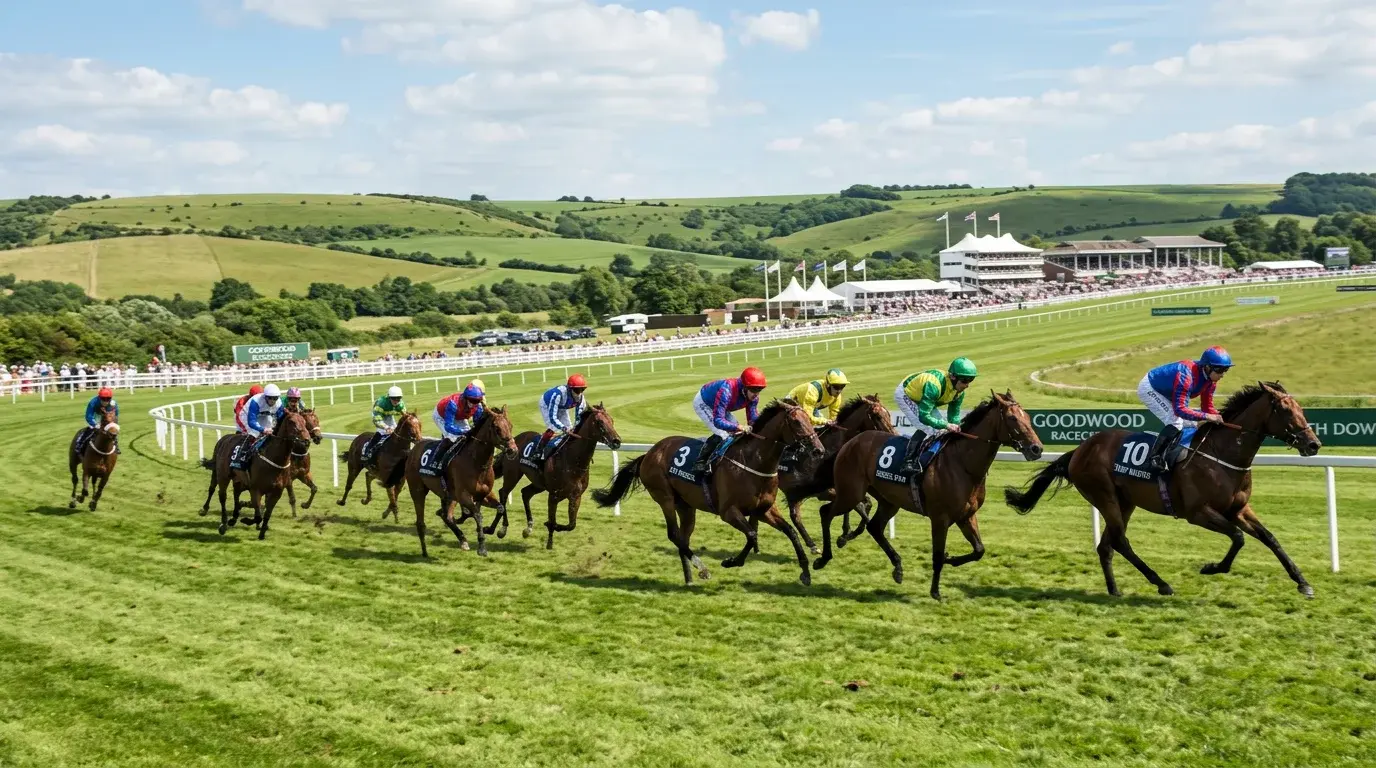
What makes Goodwood different is the course itself. Built on the Sussex Downs above Chichester, the track rolls and undulates in ways that confound horses accustomed to flat, level circuits. The camber, the gradient changes, and the tight turns demand a specific type of horse — one that handles the terrain as well as the opposition. That terrain factor is the edge that form students can exploit, because the betting public often underestimates how much the course characteristics influence results.
Goodwood Course Topography: Evaluating the Undulating Downland Track
Goodwood is a right-handed course with a pronounced undulating profile. The five-furlong sprint course drops sharply downhill before levelling out for the final furlong and a half, rewarding horses that can change gear on a gradient. The mile course includes a sweeping right-hand turn with a downhill camber that unbalances horses with high actions or those that lack coordination at speed. The longer trips — a mile and a half and beyond — navigate the full circuit, including uphill sections that test stamina beyond what the raw distance suggests.
The practical consequence for bettors is that Goodwood form is Goodwood form. A horse that has won around the Sussex circuit has demonstrated an ability to handle terrain that many rivals have not faced. When I see a horse returning to Goodwood with a previous course victory, it moves up my shortlist regardless of its recent form elsewhere, because the track bias is strong enough to override marginal form differences. Conversely, debutants at Goodwood — horses that have never raced on a track like this — carry an uncertainty that the market often does not price fully.
The draw matters at Goodwood, but in less predictable ways than at tracks like Chester or Beverley. On the sprint course, low draws (near the stands rail) tend to have an advantage when the ground is on the soft side, because the rail provides a reference line and the ground nearer the inside often rides faster. On the round course, the draw’s influence is more dependent on the pace of the race — a fast pace allows hold-up horses to take whatever path they choose, while a slow pace gives inside draws an edge by reducing the distance covered. Monitoring how the draw has played over the first day or two of the festival, and adjusting selections for the remaining days, is a practical approach that consistently adds value.
Feature Races and Markets Across the Five-Day Card
The flagship race is the Sussex Stakes, a Group 1 mile contest that regularly attracts the best milers in Europe. The Sussex Stakes is the midsummer championship, and its market is typically dominated by the top two or three in the ante-post betting. The betting interest concentrates on whether the favourite can handle Goodwood’s quirks — the 2000 Guineas winner does not automatically translate to a Sussex Stakes winner, because Goodwood demands balance and acceleration that Newmarket’s flat, galloping track does not test.
The Nassau Stakes is the feature race for older fillies and mares, and it often produces compelling betting heats. The mile-and-a-quarter trip on Goodwood’s undulating course sorts out horses that lack tactical speed, and the fields are typically 8-12 runners with genuine depth of quality. The Goodwood Cup — a two-mile Group 1 for the stayers — is a more specialist contest with smaller fields but a dedicated ante-post market that opens months before the meeting.
For betting purposes, the most valuable races at Goodwood are the competitive handicaps that fill the supporting cards. The Stewards’ Cup aside — which deserves its own section — races like the Golden Mile, the Molecomb Stakes, and the Thoroughbred Stakes offer large fields, open markets, and the kind of competitive uncertainty that rewards form study. Goodwood’s Premier Fixture status means these supporting races attract quality fields that produce genuine betting opportunities rather than the thin, predictable cards you see at lesser meetings. Comparing the Goodwood approach with betting at Royal Ascot highlights how different festival environments reward different strategies.
The Stewards’ Cup: Betting on a Big-Field Sprint Handicap
The Stewards’ Cup is the Saturday feature of the Goodwood festival and one of the most anticipated handicap sprints of the flat season. Run over six furlongs, it typically attracts 20-28 runners, making it one of the largest fields assembled anywhere on the British flat calendar. The ante-post market opens weeks in advance and draws significant volumes of money, with the favourite rarely starting at shorter than 6/1 and the winner frequently coming from double-figure odds.
The draw is a significant factor in the Stewards’ Cup, and its influence varies depending on the ground and the race pace. Historical data shows that in recent years, higher draws — those racing towards the far side (the stands rail) — have had a statistical advantage, particularly when the ground is on the quicker side. On softer ground, the advantage shifts towards the centre or lower draws. The complicating factor is that the draw’s influence in any specific running depends on where the pace is — if the speed horses are all drawn high, the far side will be favoured regardless of the ground, because that is where the race will be run.
My approach to the Stewards’ Cup combines three filters. First, proven form at Goodwood or at similarly undulating tracks — this eliminates horses whose previous sprint form was achieved on flat, galloping courses. Second, a favourable draw based on the prevailing ground conditions and the likely pace scenario. Third, a handicapper who has not been raised out of contention since the weights were published. The intersection of these three filters typically narrows the field from 25 runners to 6-8 credible contenders, which is a workable shortlist for Dutching or individual selection.
Each-way betting is the natural approach for the Stewards’ Cup. With 20+ runners, bookmakers pay four places as standard and frequently offer extra places — five, six, or even seven places — as a promotional incentive. The combination of a big field, extra places, and a horse at 16/1 or bigger creates exactly the conditions where each-way value is maximised. If you bet on only one race at Goodwood all week, the Stewards’ Cup is the one to target.