
The Epsom Derby pulled a peak television audience of 1.3 million in 2025 — the highest in two years — and the betting market reflected that resurgence of interest with some of the deepest ante-post liquidity I have seen for the Classic in recent memory. Yet for all the money and attention, the Derby remains one of the most misunderstood races in the calendar. Punters who assess form as if Epsom were a standard galloping track are making a fundamental error. This is a track where the camber, the gradient and the undulations change the equation entirely, and the betting market consistently underestimates that reality.
Camber and Gradient: How the Epsom Track Alters Race Dynamics
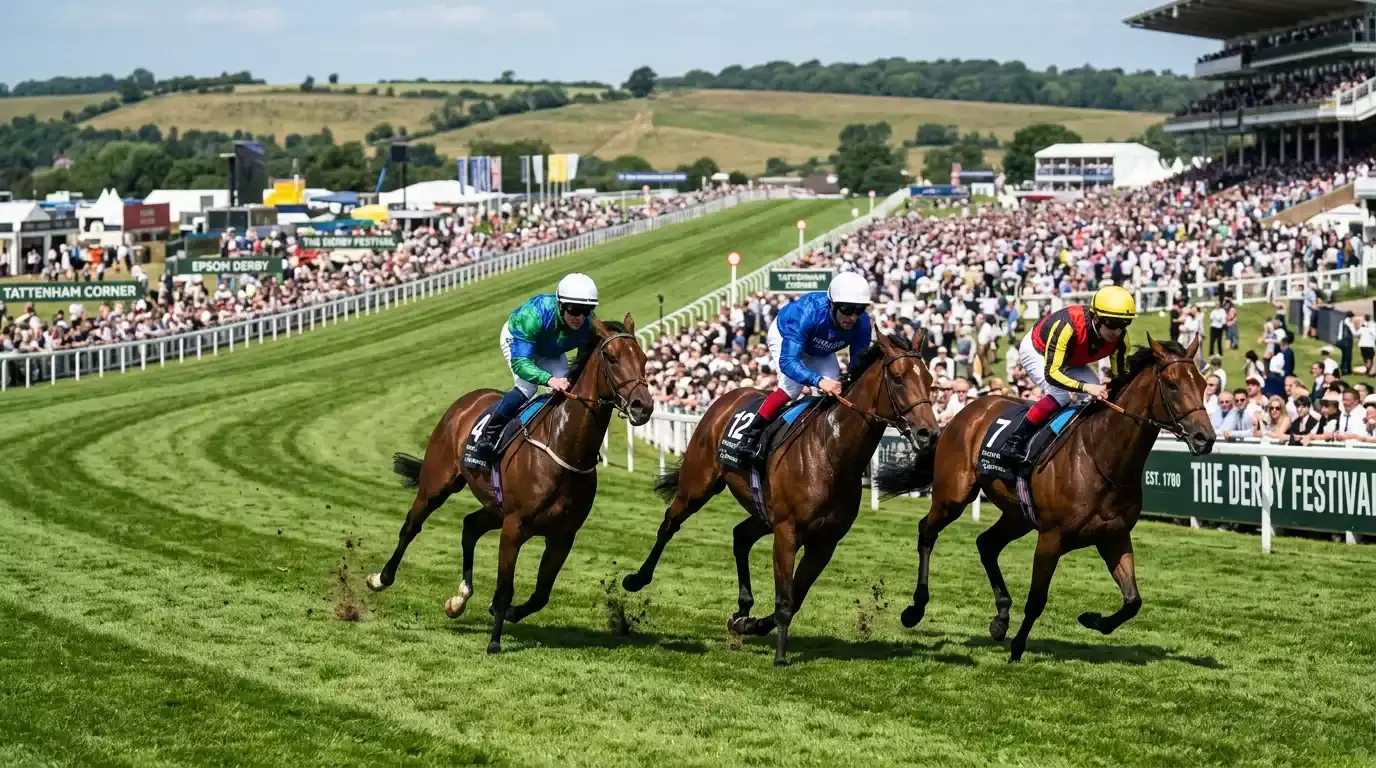
I stood on Tattenham Corner once, at ground level, during a race, and the angle of the camber genuinely surprised me. Television flattens it. In person, the track tilts towards the inside rail so sharply that horses on the outer have to fight against gravity while simultaneously navigating a 90-degree left-hand bend at close to 40 miles per hour. That is not a standard racing challenge.
The Derby course starts with an uphill climb for the first half-mile, reaches a crest near the top of the hill, and then descends steadily towards Tattenham Corner before a left-handed sweep into the straight. The straight itself has a slight uphill camber towards the stands, and the final furlong is uphill. Every section of this mile-and-a-half course demands something different from a horse: climbing ability, balance on the descent, agility through the turn, and stamina up the hill to the line.
Horses who act purely on speed — front-runners who bowl along on flat, galloping tracks — regularly fail at Epsom. The descent towards Tattenham Corner unbalances them, and the camber pushes them wide, costing ground and energy. The market often fails to discount these types sufficiently, because their trial form looks impressive on tracks that bear no resemblance to Epsom. I have made a profitable habit of opposing short-priced Derby favourites whose form has been compiled entirely on flat, left-handed galloping tracks like Newmarket. Epsom is not Newmarket. It is not even close.
What does work at Epsom? Horses who settle in behind the pace, travel efficiently through the descent, and pick up in the straight. Balance is more important than raw speed. If a horse’s form shows it can quicken after being held up — even at a shorter distance — that is a better indicator for Epsom than time figures recorded on dead-flat courses.
Assessing Three-Year-Old Form for the Derby and Oaks
The Derby is a race for three-year-olds who have never raced at the trip, on a course most have never seen, in a field size and atmosphere that none have experienced. That makes it fundamentally different from most pattern races, where form lines are well established. The question is not “which horse is the best?” but “which horse is most likely to handle conditions that are entirely new to it?”
Premier Fixture average attendance rose 5.3% in 2025, and Epsom on Derby day is a Premier Fixture in every sense — the atmosphere is unlike a standard race day, and some horses simply do not cope with the noise, the crowd density and the occasion. That is impossible to predict from form alone, but trainers’ records at the meeting are a useful proxy. Trainers who have saddled multiple Derby runners know how to prepare a horse for the sensory overload, and their horses tend to perform closer to their rating than those from yards making a first visit.
Trial races are the primary form reference. The Dante Stakes at York, the Lingfield Derby Trial, the Dee Stakes at Chester and the Leopardstown Trial in Ireland each reveal different things. The Dante is run on a flat, galloping track — it tests raw ability but tells you nothing about how a horse handles camber. Chester, by contrast, is tight and left-handed with a slight incline, and its trial winners often handle Tattenham Corner better than Dante winners do. Lingfield, uniquely, is the only trial run over the same mile-and-a-half distance on a left-handed track with a downhill stretch, making it the closest analogue to Epsom’s configuration. I weight Lingfield and Chester trial form more heavily than Dante form when building a Derby shortlist, and the market does not always agree — which is where the value appears.
For the Oaks, the same track-specific principles apply, but the filly form book is typically shallower. Many Oaks runners have had only two or three career starts by June, and the market is pricing on smaller samples. That uncertainty cuts both ways: it creates opportunities for punters who have studied the trainers and the pedigrees closely, but it also means that the favourite-bias in the market is stronger. Casual punters gravitate towards the Guineas winner or the most recognisable name, which can leave fillies from smaller yards at longer odds than their ability warrants.
Trial Races and How They Move the Derby Market
I track Derby market movements from the moment the first ante-post prices are published, usually in late March, and the pattern repeats itself every year: the market is wide and uncertain until the first trial, then it narrows sharply, then it narrows again after the second trial, and by the time final declarations are made on the Wednesday before the race it has settled into its final shape.
The Dante Stakes in mid-May is the single biggest market-moving trial. A dominant Dante winner typically sees its Derby odds halved within an hour. The Lingfield Trial, run a few weeks earlier, moves the market less aggressively because the field quality is perceived to be lower — but I have found the correlation between Lingfield Trial form and Derby performance to be stronger than the Dante correlation, precisely because Lingfield’s track configuration rewards the same attributes Epsom demands.
French and Irish form is increasingly relevant. The French Derby trials — particularly the Prix Lupin and the Poule d’Essai des Poulains — occasionally produce runners who cross the Channel for Epsom, and the UK market is slow to price them accurately because most punters are less familiar with French form. In the past five years, French-trained or French-trialled runners have outperformed their market position at Epsom more often than they have underperformed. If a horse with strong French form enters the Derby at 16/1 or bigger, it warrants serious consideration.
One final observation: the Derby market has a consistent late-drift pattern for second and third favourites. In the 48 hours before the race, money piles onto the favourite, pushing the second and third picks out by one or two points. If you have identified a selection that is not the favourite, waiting until the day before the race to place your bet often yields a better price than backing two weeks out.