
The UK sports betting market generates 2.48 billion pounds in annual Gross Gambling Yield, and most of that flows through the fixed-odds model everyone recognises — pick a horse, stake your money, collect if it wins. Spread betting on horse racing operates on an entirely different principle, one borrowed from financial markets rather than the traditional betting ring. I started experimenting with it around 2017, lost money initially because I underestimated the downside risk, and eventually found a disciplined way to use it that complements my fixed-odds activity. This guide explains the mechanics, the main markets, and — most importantly — how to manage the risk that makes spread betting fundamentally different from placing a standard wager.
Spread Betting Mechanics: Calculating Market Volatility and Risk
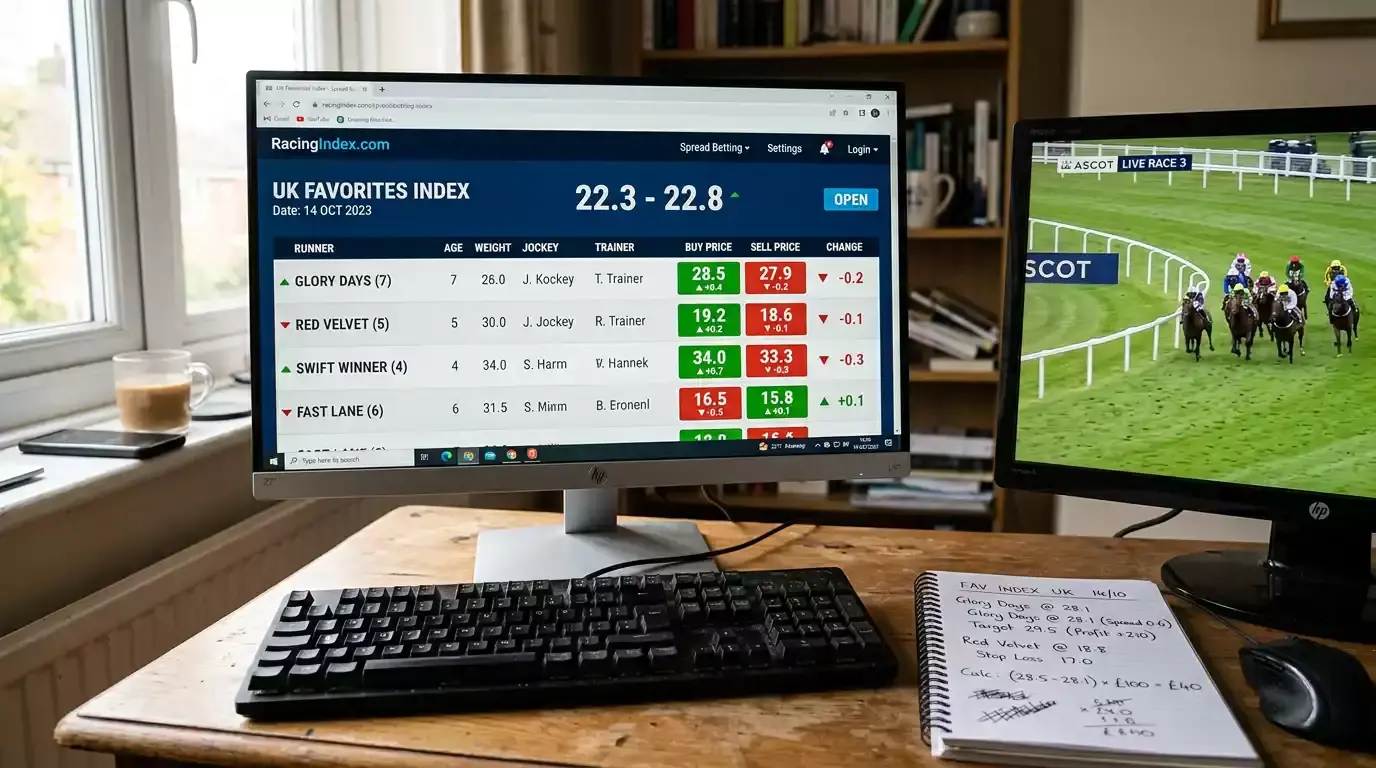
The first spread bet I ever placed was on the Favourites Index at a midweek Flat meeting. I bought at 52 for five pounds a point, confident that the favourites would perform well. Two of the six favourites won, one placed, and the index settled at 38. I lost 70 pounds — five pounds multiplied by 14 points of downward movement. It was a small loss, but it taught me the fundamental lesson: in spread betting, you do not just lose your stake. You lose in proportion to how wrong you are.
A spread betting firm — regulated by the FCA rather than the Gambling Commission, which is an important distinction — quotes a spread on a particular market. You can “buy” if you think the outcome will be higher than the top of the spread, or “sell” if you think it will be lower than the bottom. Your profit or loss is the difference between where you bought or sold and where the market settles, multiplied by your stake per point.
Take the Total Distances market for a race. The firm might quote 22-25 for the aggregate winning distances across a card of six races. If you buy at 25 for two pounds a point and the total winning distances come to 31, you profit by 12 pounds — two pounds times six points. If the total comes to 15, you lose 20 pounds — two pounds times ten points of downward movement. The key difference from fixed odds is that your loss is not capped at your initial stake. A heavy favourite winning six races by wide margins could push the distances total to 50 or beyond, and if you had sold at 22, your loss would escalate with every length.
This uncapped risk profile is what separates spread betting from every other form of horse racing wager. It is also what makes it tax-free for the punter under UK law — the same exemption that applies to all financial spread betting. Winnings from spread bets are not subject to capital gains tax or income tax, which mirrors the position for standard fixed-odds betting where the 15% duty is paid by the operator rather than the customer.
Common Spread Markets: Favourites Index, Distances and Match Bets
After that initial lesson on the Favourites Index, I spent three months paper-trading every spread market I could find before risking real money again. The variety of markets is broader than most punters realise, and each has its own risk profile.
The Favourites Index assigns points to the performance of market favourites across a card — typically 25 points for a win, 10 for second, 5 for third. The spread reflects the firm’s expectation of how well the favourites will perform collectively. Buying the index is a bet that the favourites will outperform expectations; selling is a bet that they will underperform. This market tends to be relatively low-volatility because it averages across multiple races, but it can move sharply if several short-priced favourites fail.
Race Distances — the aggregate winning distance across all races on a card — is a higher-volatility market. A single runaway winner in a maiden race can add ten or more lengths to the total, causing sudden moves against sellers. I tend to trade this market only on cards where the form suggests competitive races with close finishes, avoiding maiden or novice-heavy cards where blowouts are common.
Match Bets pit two specific horses against each other, with the spread based on the distance between them at the finish. This is the closest spread market to traditional fixed-odds thinking, because you are essentially assessing which of two horses will finish ahead. The spread is usually tight — two or three lengths — and the maximum movement is limited by the field size and race distance. Match bets are where I focus most of my spread betting activity, because the risk is more contained and the analysis maps directly onto standard form assessment.
Jockey and Trainer performance indices, total winning SPs, and cross-card accumulators are also available through the main spread firms. Each market carries its own volatility profile, and understanding that profile before you trade is not optional — it is the difference between a controlled position and an open-ended liability.
Managing Downside Risk in Spread Betting
The most dangerous sentence in spread betting is “it cannot go much further.” It can. I have seen the Race Distances market settle 40 points above the buy price on a day when three races produced wide-margin winners in succession. Without a stop loss, a seller in that market would have faced a four-figure hit from what started as a modest position.
My first risk management rule is staking discipline. I never stake more than one pound per point on any spread market unless I have a specific, data-backed reason to increase size. At one pound per point, a 20-point adverse move costs 20 pounds. At ten pounds per point, the same move costs 200 pounds. The temptation to increase stake size on “obvious” trades is where most spread betting losses originate.
The second rule is to use stop losses wherever the platform offers them. A stop loss caps your maximum loss at a predetermined level, converting an uncapped liability into a defined risk. Not all spread firms offer stop losses on all horse racing markets, but where they are available, I use them as standard. The cost is a slightly wider spread, which is a small price to pay for defined risk.
The third rule connects to my broader betting strategy: spread betting should be a complement to fixed-odds activity, not a replacement. I allocate no more than 15% of my overall racing bankroll to spread positions, and I treat each day’s spread activity as a separate session with its own stop point. If my spread losses for the day exceed a preset threshold — typically 50 pounds — I close all positions and return to fixed-odds betting for the rest of the card.
The psychological dimension is worth acknowledging. Watching a spread position move against you in real time triggers a different emotional response from losing a fixed-odds bet. A lost fixed-odds bet is a binary event — the money is gone. A spread position that is going wrong is a continuous bleed, and the temptation to hold on and hope for a reversal is strong. Having predefined exit points removes the emotional element from the decision, and that discipline is what separates profitable spread bettors from the majority who lose.