
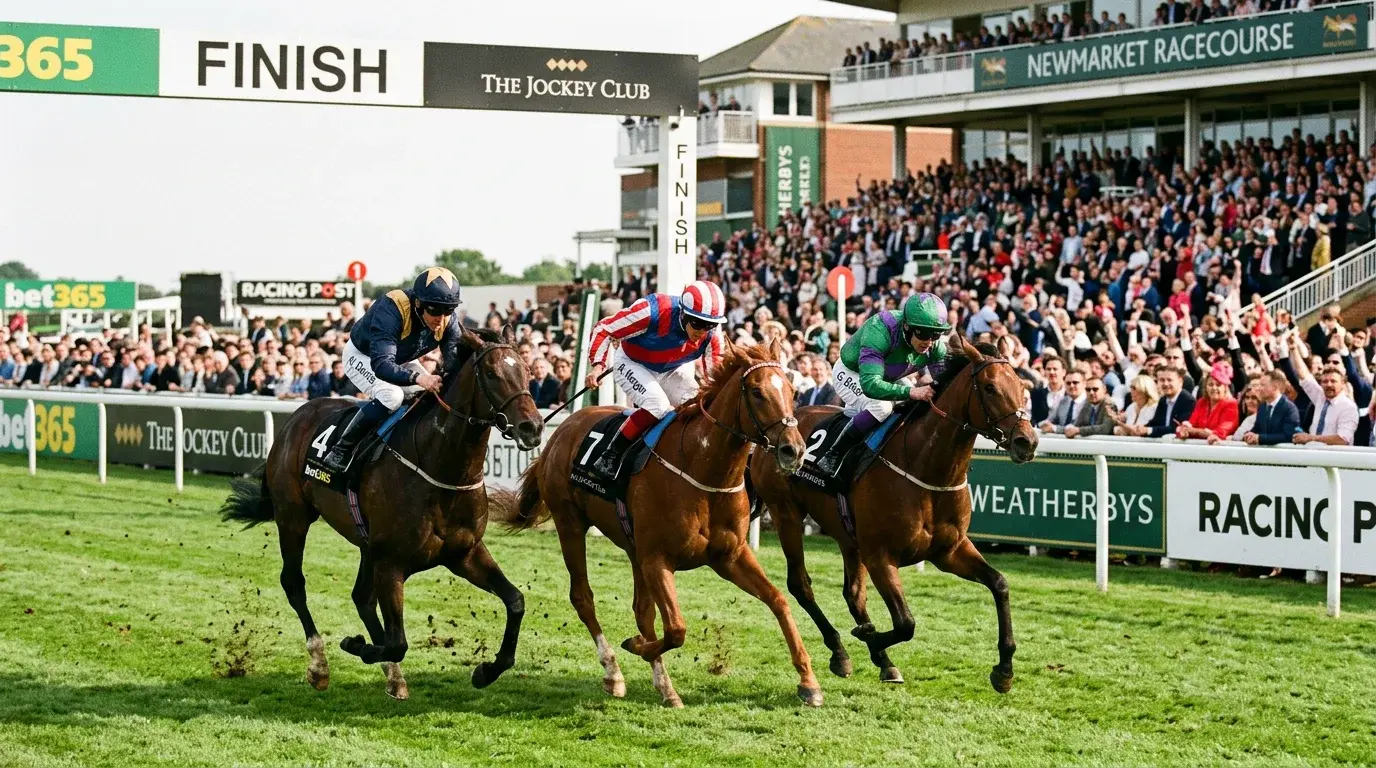
I first used Dutching almost by accident. A 14-runner handicap at Newmarket where I genuinely could not separate three horses in my form analysis. Rather than pick one and hope, I split my stake across all three, weighting each bet so that any of them winning would return the same profit. Two of them finished second and fourth. The third won at 9/1. My return was lower than if I had backed the winner as a single, but it was a return — and I would have been on the wrong one if forced to choose.
Dutching is the practice of backing multiple selections in the same race with adjusted stakes so that a win by any of them produces an equal — or near-equal — profit. It is not an exotic strategy. It is basic portfolio management applied to horse racing, and it works best in exactly the races that British racing produces most often: competitive handicaps where average field sizes sit at 8.90 on the flat and 7.84 over jumps, and where form analysis regularly points to two, three, or four credible contenders rather than a single standout.
Dutching Mathematics: Formulas for Balancing Multi-Horse Profit
The calculation is straightforward once you understand the principle. You want each selection to return the same total amount if it wins. That means the stake on each horse is inversely proportional to its odds: shorter-priced selections receive larger stakes, longer-priced selections receive smaller ones.
Here is a worked example. You want to Dutch three horses with a total outlay of £30. The odds are 3/1, 5/1, and 8/1. First, convert each to implied probability: 3/1 = 25%, 5/1 = 16.67%, 8/1 = 11.11%. Add those percentages: 25 + 16.67 + 11.11 = 52.78%. Each stake is calculated as (individual implied probability / total implied probability) x total outlay. So the 3/1 shot gets (25 / 52.78) x £30 = £14.21. The 5/1 shot gets (16.67 / 52.78) x £30 = £9.47. The 8/1 shot gets (11.11 / 52.78) x £30 = £6.32. Check: if the 3/1 wins, you receive £14.21 x 4 = £56.84, minus your £30 outlay = £26.84 profit. If the 8/1 wins, you receive £6.32 x 9 = £56.88, minus £30 = £26.88 profit. The returns are essentially equal, which is the point.
The critical number to watch is the combined implied probability. In the example above, 52.78% means your combined selections represent just over half the market. That leaves a 47.22% chance that none of your horses wins, and in that scenario you lose your entire £30. For Dutching to be profitable over time, the true probability of your selections winning must exceed the combined implied probability — in other words, the combined odds must represent value, not just coverage.
This is where the difference between Dutching and simply backing the field becomes important. Dutching three horses at fair odds guarantees a loss over time because the bookmaker’s overround ensures that the combined implied probabilities of all runners exceed 100%. You need to believe that your three selections are genuinely underpriced relative to their actual chances. If the market has the three of them at a combined 52.78% but your analysis says the true probability is closer to 60%, you have a profitable Dutch.
When Dutching Beats a Single Win Bet
Dutching is not always the right approach. It sacrifices upside — your return on any individual winner is smaller than it would have been with a single-selection bet. The trade-off is reduced variance: you win more often, but each win returns less. The question is when that trade-off makes sense.
Competitive handicaps are the prime Dutching territory. In races where form analysis cannot reliably separate the top three or four contenders, forcing yourself to pick one is essentially adding a coin flip on top of your form assessment. You have done the work to identify the three most likely winners; Dutching lets you profit from that analysis without needing to guess which of the three actually prevails. This is particularly relevant in British racing where average turnover per race on Core Fixtures has dropped 14.4%, meaning thinner markets and more potential for mispricing across multiple runners rather than just one.
Dutching also works well in races with a clear pace angle. If you believe the race will be run to suit hold-up horses but cannot determine which of the closers will get the best run, backing all three closers as a Dutch is cleaner than trying to predict race dynamics that depend on jockey decisions and post positions. You are backing the pace scenario, not the individual horse.
Where Dutching does not work: short-priced races with an obvious favourite. If one horse is 6/4 and the rest are 8/1 or bigger, the market has already identified the most likely winner, and Dutching the outsiders just increases your cost of entry without improving your edge. Similarly, Dutching too many selections inflates the combined implied probability to the point where you need an unrealistically high true probability to break even. Three is usually the sweet spot; four is workable; five or more is almost always a sign that you have not done enough work to narrow the field.
Tools and Shortcuts for Quick Dutching Calculations
Running the maths by hand is fine for understanding the concept, but in practice you need speed — especially if you are Dutching across different bookmakers to get the best odds on each selection. Several free Dutching calculators exist online and as mobile apps. The standard workflow is: enter the odds for each selection, enter your total stake, and the calculator spits out individual stakes and projected returns instantly.
The most useful feature in a good Dutching calculator is the ability to toggle between equal-profit and equal-stake modes. Equal-profit mode is what we described above — variable stakes producing identical returns. Equal-stake mode splits your money evenly regardless of odds, which produces unequal returns but is simpler and occasionally preferable when you rate each selection equally and want maximum exposure to the longest-priced runner.
Betfair’s exchange interface includes a built-in Dutching function that lets you select multiple runners and automatically calculate stakes. This is useful because exchange odds are typically closer to true probability than bookmaker odds, making the combined implied probability lower and the Dutch more likely to be value. The commission structure on the exchange — usually 2-5% on net winnings — is factored into the calculator, so the projected returns you see are net of fees.
A practical shortcut I use regularly: if I cannot be bothered running numbers, I ask whether backing my top two selections at their current prices would return more than my total outlay if either wins. If yes, the Dutch is viable. If not, the prices are too short. This rough filter eliminates obviously unprofitable Dutches in seconds and lets me focus the calculator on the borderline cases where the numbers genuinely need checking. Integrating Dutching into your broader betting strategy is about recognising which races suit the approach and which are better served by a single, confident selection.