
Extra-place offers are one of the few promotions in horse racing betting that deliver genuine, quantifiable value rather than marketing noise. The concept is simple: a bookmaker extends the standard each-way terms to pay out on more places than the industry default. Instead of paying the first three in a 16-runner handicap, an extra-place offer might pay the first four, five, or even six. That additional place fundamentally changes the mathematics of each-way betting and, in the right races, can shift the expected value of a bet from marginal to clearly positive.
With average field sizes of 8.90 on the flat and 7.84 over jumps, extra-place offers are concentrated in the races where fields are largest and the standard place terms are most restrictive relative to the number of runners. Big-field handicaps at major festivals are the prime territory — exactly the races that attract the most betting interest and the most promotional activity from bookmakers competing for your business.
Extra-Place Mechanics: Evaluating Each-Way Value in Large Fields
Standard each-way place terms in British racing are set by the number of runners. In a race with 5-7 runners, the first two places pay. At 8-15 runners, the first three. At 16 or more runners, the first four — or, in handicaps of 16+, the first four at 1/4 odds. These are the default terms offered by every bookmaker, and they are the baseline against which extra-place offers are measured.
An extra-place offer adds one or more positions to this standard. A “5 places” offer on a 20-runner handicap means your each-way bet pays out if your horse finishes first through fifth, rather than first through fourth. The place part of the bet — typically at 1/4 or 1/5 of the win odds — is extended to cover the additional position. No other terms change: the win part of the bet still requires your horse to finish first, and the fraction of the odds paid on the place part remains as advertised.
The value of this extension depends on the probability of a horse finishing in the extra place position. In a 20-runner race where the bookmaker pays five places instead of four, the extra value comes from the probability that your horse finishes exactly fifth. For a horse at 14/1, that might be an 8-10% chance — small individually but substantial across a season of bets. Over 100 each-way bets on 14/1 shots, roughly 8-10 of them will finish exactly in the extra place position, and each one returns around 3.5 times your place stake. That is meaningful edge.
Some operators go further, offering six or even seven places on the biggest fields — the Grand National at 40 runners, the Cesarewitch, the Cambridgeshire, or major festival handicaps. These extreme extra-place offers are loss leaders designed to attract customers, and they represent the best each-way value available anywhere in horse racing betting.
Which Races and Bookmakers Offer Extra Places
Extra-place offers are not available on every race. They cluster around specific categories: big-field handicaps with 16 or more runners, festival feature races, and Saturday afternoon highlights that attract high betting volumes. Bookmakers use extra places as a promotional tool, so the offers appear where the audience is largest — the same reason supermarkets discount bread and milk rather than artisanal olive oil.
The festival calendar is the richest hunting ground. During the peak festival season, when participation in horse racing betting spikes to around 7% of UK adults compared to 4% during the off-season, bookmakers compete aggressively for new and returning customers. The Cheltenham Festival, Royal Ascot, the Grand National meeting, and Glorious Goodwood all trigger waves of extra-place offers. Some bookmakers advertise “extra places on every race” for the duration of a festival, which is exceptionally generous if taken at face value.
The key comparison is between operators. Not all extra-place offers are equal. One bookmaker might offer five places on a 20-runner race at 1/4 odds while another offers five places at 1/5 odds. The first is significantly more valuable. Similarly, some operators restrict extra places to bets placed before a certain time — often 10am on race day — while others offer them right up to the off. Checking the terms across three or four bookmakers before placing an each-way bet on a big handicap is standard practice for anyone serious about extracting value from these promotions.
It is also worth combining extra-place offers with free bet promotions. A free bet placed each-way on a big-field handicap with extra places is one of the highest expected-value plays available to any bettor, because the downside — losing the free bet — costs you nothing, while the upside includes both the win and the extended place terms.
Worked Payout: Standard Terms vs Extra Places
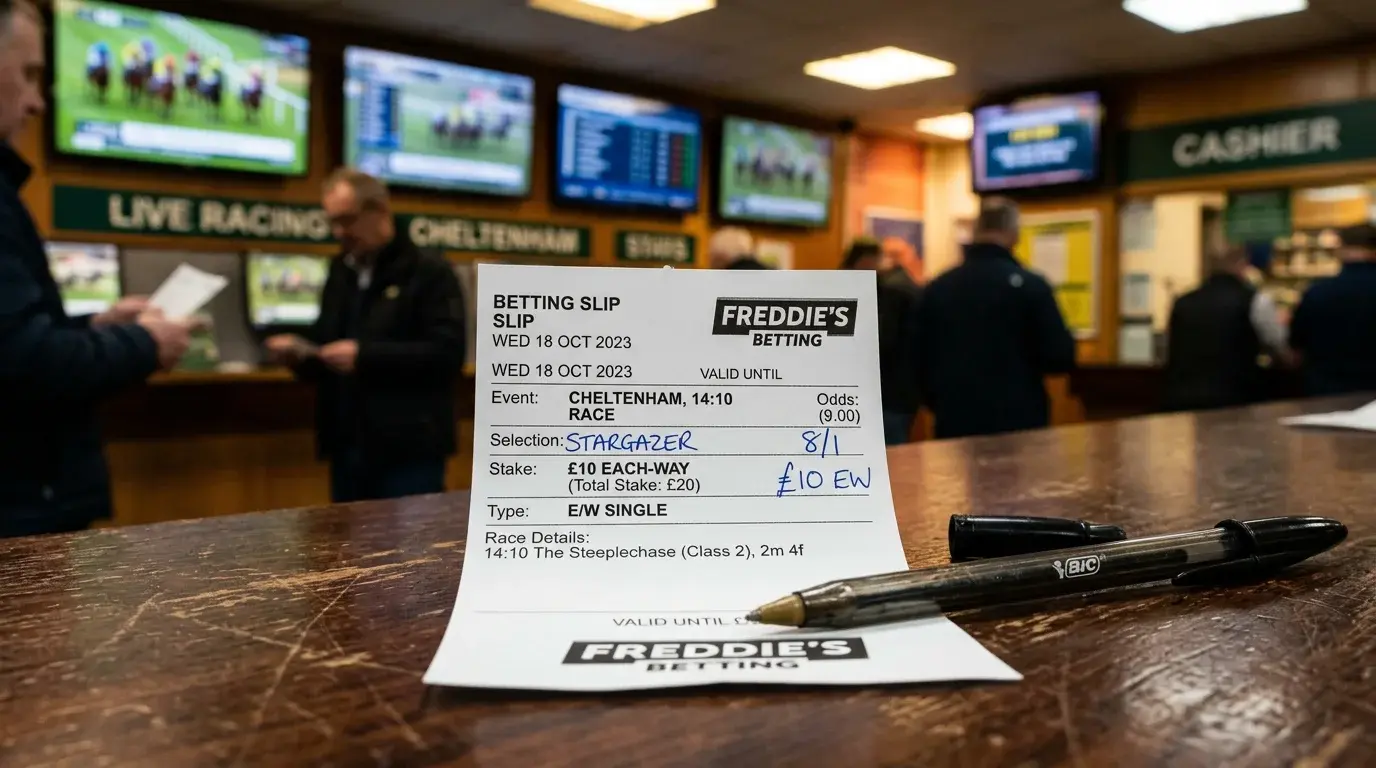
Let me walk through a concrete example. You back a horse at 16/1 each-way in a 22-runner handicap with a £5 each-way stake (£10 total). Under standard terms, the place part pays 1/4 odds on the first four places.
If the horse finishes fourth: the win part (£5 at 16/1) loses. The place part (£5 at 4/1, which is 16/1 divided by 4) returns £5 x 4 + £5 stake = £25. Your net profit is £25 minus £10 total outlay = £15. If the horse finishes fifth under standard terms: both parts lose. You are down £10.
Now apply an extra-place offer paying six places at 1/4 odds. If the horse finishes fifth: the win part still loses, but the place part now pays. You receive £5 at 4/1 = £25. Net profit: £15. If the horse finishes sixth: same calculation, same £15 profit. Under standard terms, finishing fifth or sixth returns nothing. Under six-place terms, both positions return £15 each.
Across a portfolio of bets, this difference compounds. If you place 50 each-way bets at an average of 14/1 on horses in big handicaps over a season, statistical expectation says roughly 4-5 of those horses will finish in the extra place positions. At £5 each-way stakes, that is approximately £60-75 in additional returns that you would not have received under standard terms — pure edge, delivered by the promotion rather than by superior form analysis.
The worked example also illustrates why extra places are most valuable at higher odds. A horse at 3/1 finishing in the extra place position returns just £5 x 0.75 + £5 = £8.75 on a £5 place stake. At 16/1, the same position returns £25. The extra-place edge scales with the odds of your selection, which is why targeting longer-priced each-way runners in big handicaps maximises the value of these offers.