
The first time going conditions properly cost me was at Haydock on a November Saturday. I had backed a well-handicapped five-year-old off strong form — three wins from four starts, progressive profile, decent jockey booking. What I had not bothered to check was that all three wins came on good to firm ground and the overnight rain had turned Haydock into a ploughed field. The horse hated every stride and trailed in last of nine. The winner, a mudlark with form figures full of soft-ground victories, was sent off at 12/1 because most of the market had made my exact mistake.
Across Britain’s 59 racecourses — 19 exclusively flat, 24 jumps-only, and 16 dual-purpose — the terrain and drainage vary so dramatically that the same official going description can mean completely different things at different tracks. Soft at Cheltenham, with its natural hill drainage, is not the same as soft at Lingfield’s clay-based turf. Understanding the going scale, how it is measured, and how to apply it as a betting filter is one of the most reliable edges available to anyone studying horse racing form.
The Going Scale: Evaluating Speed Differences from Hard to Heavy
The official going scale in Britain runs from hard at one extreme to heavy at the other, with seven recognised descriptions in between. In practice, you will rarely see the extremes. Hard ground is dangerous and usually prompts abandonments; most courses water the track well before conditions reach that stage. Heavy is more common, particularly over jumps in winter, though even that often leads to non-runners as trainers withdraw horses that cannot handle it.
The working scale runs: firm, good to firm, good, good to soft, soft, heavy. Each step represents a meaningful change in how the surface plays. On firm ground, the turf is dry and the topsoil offers minimal give. Horses with a high cruising speed and efficient action tend to excel because the surface rewards momentum. Times are fast, the kickback is minimal, and stamina is less of a factor because the ground does not sap energy.
Good is the baseline that most horses handle. It offers enough cushion to protect joints while remaining fast enough for speed horses to perform. Good to firm and good to soft are the transitional descriptions — and they are where the betting value often lives, because these tweener descriptions force you to decide whether a horse’s preference leans one way or the other. A runner with four wins on good and none on good to soft might cope with the extra cut, or might not. That uncertainty creates mispriced odds.
Soft and heavy ground transform racing into a test of stamina and jumping technique. Horses that bowl along on the surface are replaced by animals that power through it. Stride length shortens, energy expenditure increases, and races are won in the final furlong by horses with reserves rather than speed. This is where going preference becomes a genuine predictor: the correlation between past soft-ground form and future soft-ground performance is significantly stronger than the equivalent correlation on quicker ground, because extreme conditions expose weaknesses that moderate conditions mask.
How Going Is Measured: GoingStick Readings and Clerk Inspections
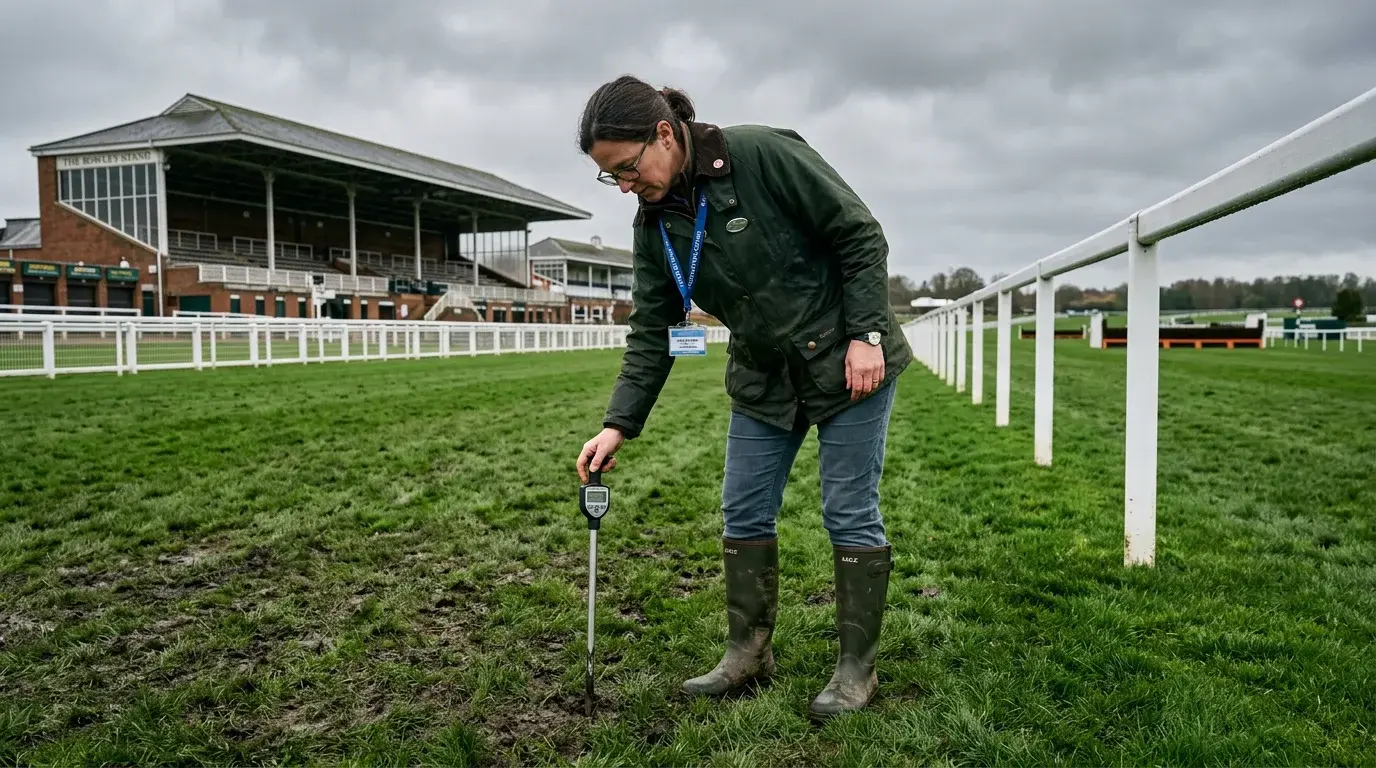
For decades, the going was determined by a clerk of the course walking the track in wellington boots and prodding the ground with a stick. That subjective assessment — one person’s opinion of how the turf felt underfoot — was the entire basis for market-moving information. The system worked tolerably well at the top level, where experienced clerks knew their tracks, but it was wildly inconsistent across the sport.
The GoingStick changed that. Introduced by TurfTrax, the device measures the shear strength of the turf and the penetration depth of a standard probe. It produces a numerical reading on a scale where higher numbers mean firmer ground. A reading above 8.0 generally corresponds to good to firm; 6.0-7.0 is good; below 5.0 suggests soft or worse. The numbers are taken at multiple points around the track and published alongside the official going description, giving punters a second, more granular data point.
The gap between the GoingStick reading and the official description is where experienced bettors find edges. A clerk might call the ground “good” but the stick readings show 5.8 across the back straight — closer to good to soft. That discrepancy matters because some trainers will not withdraw horses on good ground but would on good to soft, meaning the field you are assessing might not accurately reflect the conditions the horses will face. Checking the stick readings an hour before racing, comparing them to the morning inspection, and noting whether the weather has changed since the last measurement is a routine that takes two minutes and regularly changes my selections.
Watering policy adds another layer. Flat courses routinely irrigate during dry spells to maintain safe ground, and the amount of water applied varies by track and by day. A course that was good to firm on Thursday can be good by Saturday after overnight watering. Some courses announce their watering plans; others do not. Following the official track social media accounts is the most reliable way to catch this information before the bookmakers adjust their prices.
Using Going Preference as a Betting Filter
I treat going preference as the first filter, not the last. Before I look at form figures, ratings, or trainer stats, I check whether each runner in a race has proven form on today’s ground. In a race with ten declared runners on soft going, it is not unusual to find that only four or five have actually won on soft. The other five might handle it, but I am not paying to find out — I want evidence.
The method is straightforward. Every form database allows you to filter a horse’s record by going. I pull up each runner’s career stats, sort by surface, and look for a strike rate of at least 15-20% on the prevailing ground over a sample of five or more runs. Anything below that suggests the horse is either unproven or proven to dislike the conditions. Either way, it moves to the bottom of my shortlist.
Where this approach becomes powerful is in handicaps, where field sizes on the flat average 8.90 runners and over jumps 7.84. In a nine-runner handicap on heavy ground, eliminating three runners with no heavy-ground form leaves you with a six-horse race. The market rarely prices the remaining six as if they are the only realistic contenders — the eliminated runners still attract money from punters who have not done this work. That gap between the true competitive field and the perceived competitive field is your profit margin.
Going preference also interacts with distance preference. A horse that stays a mile and a quarter on good ground might not stay it on soft, because the extra energy demanded by testing ground effectively adds a furlong or more to the stamina requirement. I have seen plenty of horses drop back from a mile and a quarter to a mile on soft ground and suddenly run to their best rating. The trip was right because the going extended the effective distance. Thinking about going and distance as linked variables, rather than separate columns on a racecard, separates form readers from form glancers.