
Every April, the Grand National turns people who have never studied a form guide into enthusiastic punters for an afternoon. Horse racing participation surges to 7% of British adults during the festival season, and the National is the single biggest driver of that spike. I have watched this race from every angle — the sofa, the grandstand, the betting ring — and the one constant is that most of the money pouring into the market comes from people who treat this as a lottery. It is not a lottery. It is a handicap, and handicaps have logic. This guide is about that logic: the form factors, the weight dynamics, and the each-way arithmetic that separate informed selection from pin-sticking.
Aintree Form Factors: Weight Handicaps and Jumping Reliability
Years ago I backed a horse in the National purely on the grounds that it was a good jumper. It fell at the sixth fence. Jumping ability matters at Aintree, but it is just one variable in a race where stamina, course experience and racing weight interact in ways unique to this event.
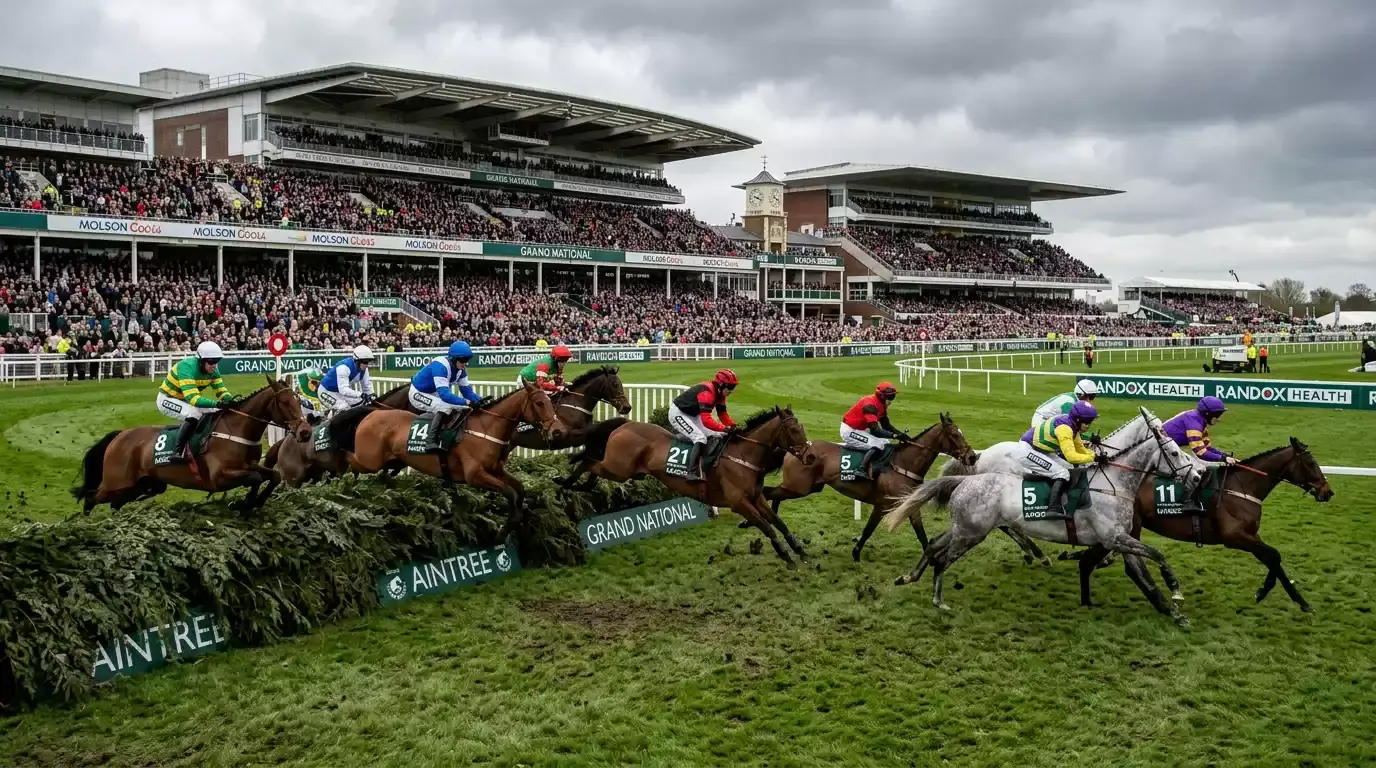
The National course is four miles and two-and-a-half furlongs, with 30 fences across two circuits. Horses need to stay every yard of it and still have enough energy to race competitively from the elbow to the winning post. Form over three miles or more is essential — I filter out any horse that has not proven it stays at least three miles in a competitive handicap chase. The drop-off rate for horses whose stamina is unproven at the trip is dramatic.
Jumping form matters, but in a particular way. The National fences are not the biggest on the chasing circuit — the Chair is an exception — but the speed at which the field approaches them in the early stages, combined with 40 runners creating traffic, means that a horse needs to be bold but not reckless. Horses with a history of front-running at speed tend to burn out or make errors when crowded. I look for horses who jump efficiently from mid-pack and have the tactical speed to improve their position from the canal turn on the second circuit.
Course form at Aintree is a strong predictor. Horses who have completed the course before — even if finishing well behind the winner — have a significantly higher completion rate than course debutants. The National fences look different from standard chase fences, the drops on the landing side are steeper, and the terrain undulates more than television coverage suggests. A horse who knows the track has a navigational advantage that is difficult to quantify in the market but is very real.
Weight is the final piece, and it connects every other factor. A horse carrying 10st 0lb over the Grand National distance is covering the same ground as a horse carrying 11st 12lb, but with nearly two stone less effort per stride. That difference compounds over 30 fences and four-plus miles.
How Handicap Weights Shape the Grand National Market
I once sat in a pub with a retired handicapper who described the Grand National weights as “an argument between ambition and arithmetic.” That is a fair summary. The BHA handicapper publishes the weights in February, and they set the parameters for every ante-post punt from that point forward.
The top weight carries around 11st 10lb to 11st 12lb, and the bottom weight 10st 0lb. The range across 40 runners means that the handicapper is separating horses by as much as 26lb — a substantial spread that rewards horses at the bottom of the weights who have been underestimated. Historically, winners cluster in the 10st 0lb to 11st 0lb range, not because the best horses run off low weights but because the energy cost of carrying extra weight over this distance is exponential rather than linear.
The 68% of racegoers who are casual or first-time visitors, many of them National-day punters, tend to back familiar names near the top of the market. These are usually the highest-rated horses carrying the most weight. That behaviour pushes the odds on top weights shorter than the form warrants and leaves longer prices on lower-weighted horses whose form figures require more research to decode. The market inefficiency is right there, every year, and it persists because the influx of casual money overwhelms the signal from informed punters.
I always cross-reference the official weight with recent handicap form. A horse who has been raised in the weights after a recent win may be poorly treated at its new mark, while a horse who has not run for a few months may have slipped under the radar. The gap between the published weight and the horse’s likely competitiveness at that weight is where the edge sits.
Each-Way Strategy for a 40-Runner Handicap
The Grand National is one of the few races where the each-way market works unambiguously in the punter’s favour, and I spend more time on my each-way strategy for this race than on any other single bet of the year.
Standard each-way terms for the National are 1/4 odds for the first four places, but most major bookmakers extend this to five, six or even seven places as part of their Grand National promotions. Those extra places change the arithmetic significantly. On a horse at 25/1, the place part of an each-way bet pays 25/4 — that is 6.25/1 — and getting paid at those odds for finishing, say, sixth in a 40-runner race is genuine value. The implied probability of finishing in the top six or seven from a field of 40 is much higher than the place odds suggest, especially for horses in the 16/1 to 40/1 range.
My approach is to identify three to five each-way selections in the 16/1 to 33/1 range, each of which I believe has a realistic chance of completing the course and finishing in the first seven. I then spread my stakes evenly across those selections rather than concentrating on one. The mathematics of each-way betting in a race this size mean that you can profit on the week even if none of your selections win, provided two or three place. That is the beauty of the National for the analytical punter — the place market is where the money is.
One tactical consideration: avoid the temptation to back horses at very long odds purely for the each-way place value. A horse at 100/1 is priced there for a reason, and the completion rate for outsiders in the National is low. The sweet spot, in my experience, sits between 16/1 and 33/1 — prices long enough to offer substantial each-way value but short enough to indicate the market takes the horse seriously as a potential finisher.