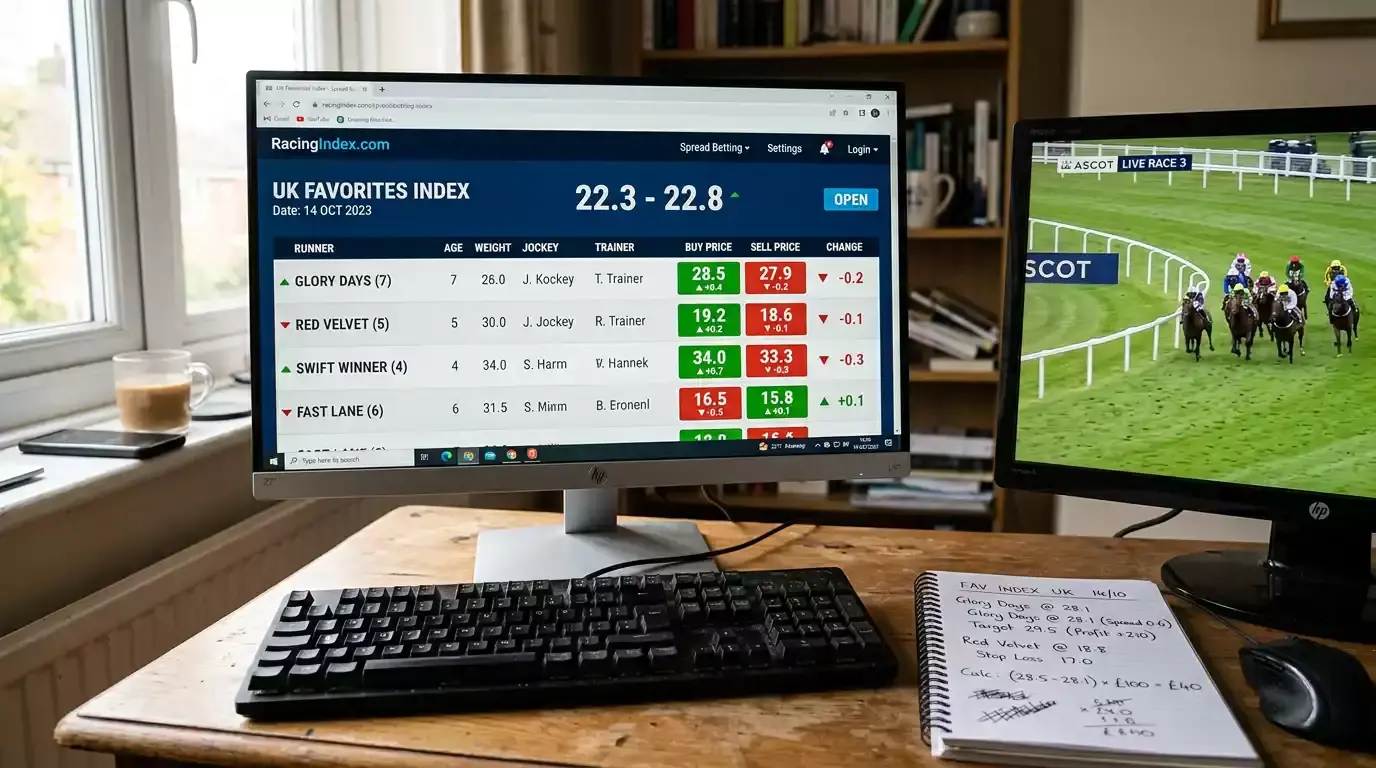

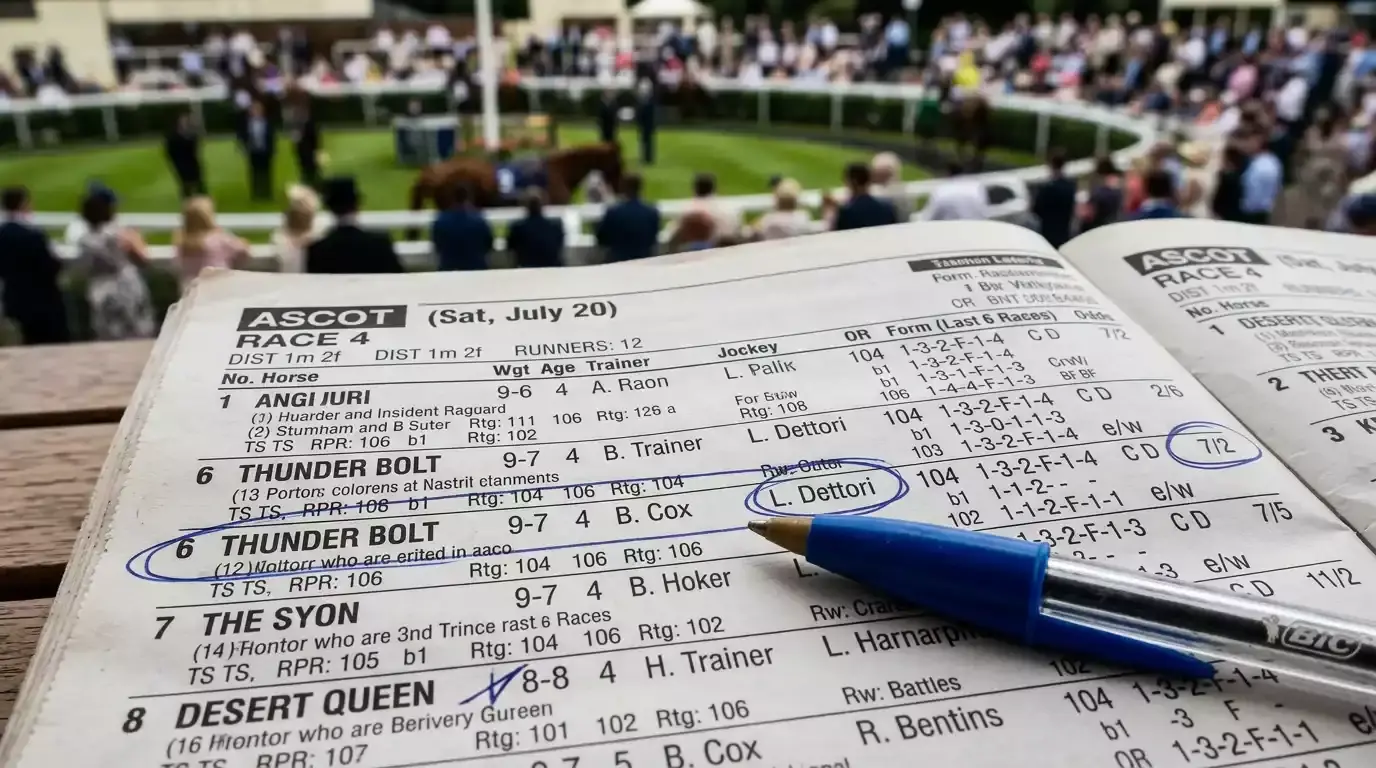
I still remember the first racecard I ever tried to read — a midweek handicap at Kempton, 12 runners, and the form column looked like someone had dropped a bowl of alphabet soup. Numbers, letters, dashes, slashes. I picked the horse with the most 1s in its recent form. It finished last. The winner had a string that read 0-5-3-2-1, and if I had known what those figures actually meant in context, I would have spotted the upward trajectory a mile off.
A form guide is the single most information-dense document in betting. Every symbol, every abbreviation, every column packs meaning that bookmakers assume you understand. With 21,728 horses currently in training across Britain — a number that shrinks by roughly 1.5% each year — the pool of runners gets tighter, and form becomes more predictive, not less. Fewer horses means more repeat match-ups, more reliable patterns, and more opportunities for anyone willing to decode the data rather than guess.
This guide breaks down every element you will encounter on a standard racecard, from raw finishing positions to the performance ratings that separate a serious form student from a pin-sticker. No jargon left unexplained, no symbol skipped.
Form Figures Decoded: Translating Historical Race Data
A friend once told me he only backs horses with “all single digits” in the form line. He meant well, but he was reading the numbers as scores rather than finishing positions — and missing half the alphabet that sits between them. The form string is a left-to-right timeline of a horse’s most recent runs, newest on the right. Each character tells you exactly what happened.
The digits 1 through 9 represent finishing positions. A 1 means the horse won; a 9 means it finished ninth. Simple enough. But the moment a horse finishes tenth or worse, the form guide replaces the number with a 0. That single zero is doing a lot of heavy lifting — it could mean tenth of twelve or twenty-second of forty in the Grand National. Context matters, and you get that context by clicking into the individual race record, not from the summary string alone.
Then come the letters. P means the horse was pulled up — the jockey stopped riding, usually because the horse was beaten, struggling, or not jumping safely. F is a fall, specific to jump racing, and it carries different weight depending on the fence. A fall at the last when travelling well is a very different story to a fall at the third when already tailing off. U stands for unseated rider, meaning the jockey came off but the horse did not technically fall — often a stumble on landing or a peck that unbalanced the partnership. R indicates a refusal: the horse declined to jump or, in flat racing, refused to enter the stalls.
Two less common but important letters: B for brought down, meaning another horse’s fall caused this one to stop, and S for slipped up on the flat. A hyphen or slash separates individual runs, and a forward slash (/) marks a break between racing seasons. When you see something like 1/32-1P, you are looking at a horse that won its last start of one season, came back next term to finish third, second, and first, then got pulled up most recently. That P at the end does not erase the form — it demands investigation. Was the ground wrong? Did it pick up an injury? Was the race too far?
The real skill is reading the trajectory. A string of 5-4-3-2 tells you far more than a single 1 followed by 6-7-8. The first horse is improving; the second is declining. I would rather back the improver at 8/1 than the fading former winner at 3/1 every single time.
Key Stats on a Racecard: OR, RPR, TS, Distance, Going
The numbers that flank the form string are where the real edge lives. I spent my first two years betting on horse racing ignoring everything except finishing positions, and I was essentially gambling blind. The moment I started cross-referencing Official Ratings with Racing Post Ratings, my strike rate jumped — not because I became smarter overnight, but because the data was doing the thinking for me.
The Official Rating (OR) is assigned by the BHA handicapper and determines which races a horse can enter and how much weight it carries. Think of it as a government-issued ability score. A horse rated 85 in a 0-90 handicap is near the top of the band and carries more weight; a horse rated 72 in the same race gets a significant weight pull. The question is whether that weight advantage compensates for the ability gap. OR is public, transparent, and moves predictably — up after a win, down after a sequence of poor runs.
The Racing Post Rating (RPR) is an independent performance figure generated after each run. Unlike OR, which is forward-looking and prescriptive, RPR is retrospective: it tells you how well the horse actually ran on the day, adjusted for weight, distance beaten, and race quality. When a horse’s RPR consistently exceeds its OR, you are looking at a runner that is outperforming its official mark — precisely the type that wins handicaps before the handicapper catches up. The Topspeed figure (TS) takes a different approach entirely, measuring raw sectional and finishing speed on a standardised scale. It is most reliable on flat, galloping tracks where pace data is clean, and less useful over jumps or on tight, undulating courses.
Distance and going columns round out the statistical picture. Every racecard shows a horse’s proven range — the shortest and longest trips at which it has won or placed. A horse unraced beyond a mile being stepped up to a mile and a quarter is an unknown quantity at the trip, no matter how impressive its form figures look. Going preference works the same way: a column marked “good to firm” four times and “soft” zero times tells you everything about where this horse wants to be. With average field sizes down to 8.90 on the flat and 7.84 over jumps, smaller fields amplify the importance of these suitability factors. In a six-runner race, one horse on its wrong ground is already a massive percentage of the field eliminated. Applying form data to your broader betting strategy turns these individual numbers into a coherent decision framework.
Trainer and Jockey Stats: What to Look For and What to Ignore
Last spring I backed a 14/1 shot at Newbury purely because the trainer had a 31% strike rate with first-time handicappers over that course and distance. The horse had unremarkable form figures — 5-4-6 — but the trainer pattern was screaming. It won by three lengths. Trainer and jockey statistics sit on every racecard, and most punters scroll right past them.
Trainer stats worth tracking: strike rate at the specific course, strike rate with the race type (first-time out, handicap debut, class drop, distance change), and current form over the past 14 days. A trainer running at a 22% overall strike rate but 9% in the last fortnight is in a cold spell — equipment, feed, illness, or just bad luck. Conversely, a yard hitting 35% over the last two weeks is firing and deserves extra attention regardless of individual form figures. Seasonal patterns matter enormously in jump racing: some trainers point everything at the autumn, others peak at the spring festivals, and the data is right there on the card.
Jockey statistics deserve a more sceptical eye. A top jockey has a high strike rate partly because top trainers book them for their best horses. The stat flatters the rider but really reflects the quality of the mount. What you want is the combination: a specific jockey on horses trained by a specific trainer at a specific course. That three-way intersection cuts through the noise. If a conditional jockey — one still claiming a weight allowance — rides for a trainer who rarely uses claimers, pay attention. The booking itself is the signal; the trainer thinks the horse needs the weight relief more than an experienced pair of hands.
What to ignore: headline season tallies with no context, jockey rankings based on prize money alone, and any “trends” built on samples smaller than 20 runs. A 50% strike rate from four rides is meaningless. A 19% strike rate from 200 rides tells you something real.