
A Lucky 15 is one of those bets that sounds complicated until you break it down, and then it turns out to be one of the most practical structures in horse racing. Four selections, 15 bets, and a built-in safety net that means even a single winner generates a return. During the peak festival betting season, when around 7% of UK adults are actively betting on racing, the Lucky 15 is probably the most popular full-cover bet placed in British betting shops and online — and for good reason. It rewards form study across multiple races without demanding perfection.
I started using Lucky 15s regularly about six years ago after losing one too many four-fold accumulators where three legs won and the fourth fell at the last. The accumulator paid nothing. A Lucky 15 on the same four selections would have returned a healthy profit from the three winning singles, the three winning doubles, and the one winning treble. The lesson was expensive but permanent: if you rate four horses strongly enough to include them in a multiple, a Lucky 15 captures more of that analysis than an accumulator ever can.
Lucky 15 Anatomy: Breaking Down the 15 Cover Bets
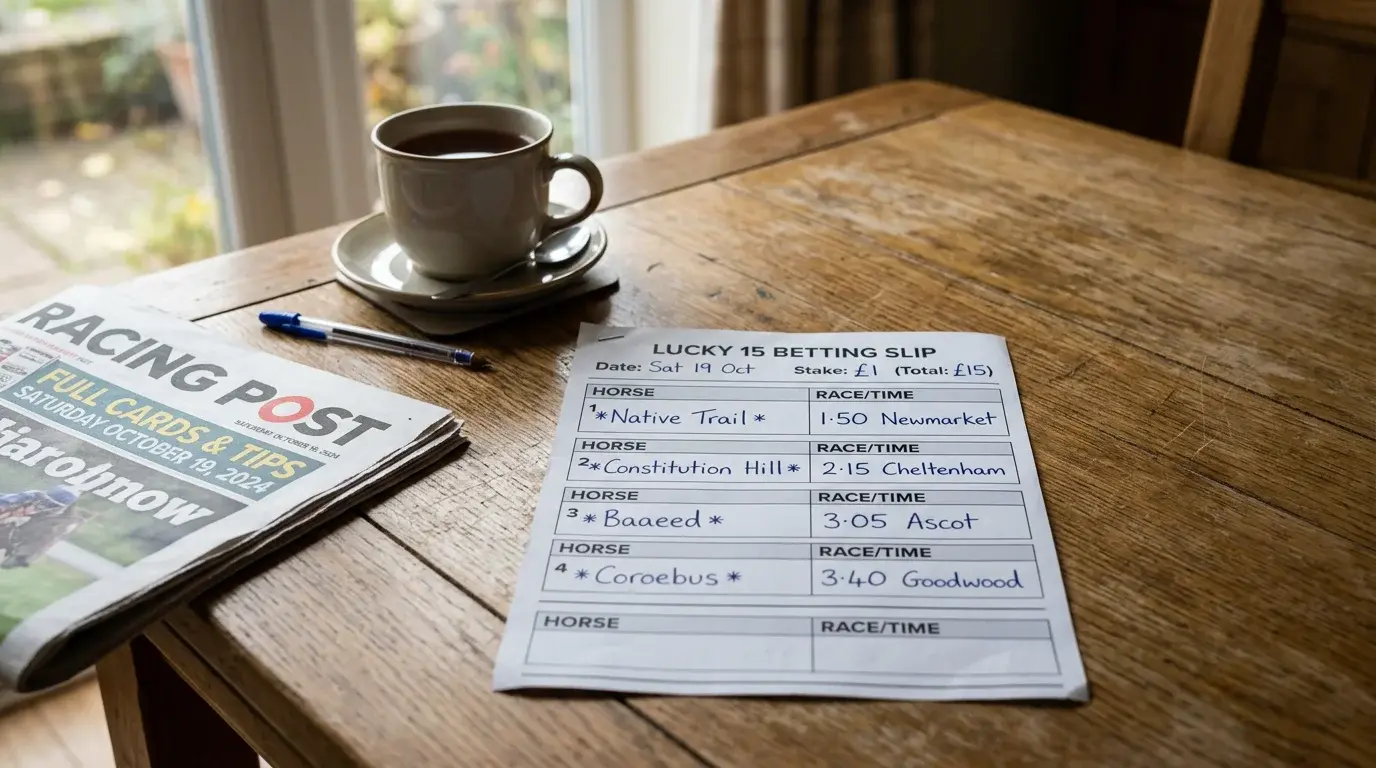
The Lucky 15 consists of every possible combination of bets from four selections. That gives you 4 singles (one bet on each individual horse), 6 doubles (every pair of two), 4 trebles (every group of three), and 1 fourfold accumulator. Fifteen bets in total, each at the same unit stake. A £1 Lucky 15 costs £15.
The structure means that your bet has multiple layers of return. If one horse wins, you collect on one single. If two win, you collect on two singles and one double. Three winners gives you three singles, three doubles, and one treble. All four winning gives you the full 15 bets as winners: four singles, six doubles, four trebles, and the fourfold. Each additional winner does not just add a bet — it multiplies the number of winning combinations exponentially.
Here is where the Lucky 15 differs fundamentally from an accumulator. A four-fold accumulator is a single bet that requires all four selections to win. One loser and the entire stake is gone. A Lucky 15 treats each selection independently through the singles and then combines them in every possible way. The accumulator element is still there — the fourfold is part of the Lucky 15 — but it is supplemented by 14 other bets that do not require all four to oblige.
The cost is the obvious trade-off. A £1 four-fold costs £1. A £1 Lucky 15 costs £15. You are paying 15 times more for the privilege of not needing all four winners. Whether that premium is justified depends entirely on the odds of your selections and how many you expect to win. If you genuinely believe all four will win, the accumulator is more efficient. If you think two or three will win, the Lucky 15 captures significantly more value.
To compare with other full-cover bet types, a Lucky 31 extends the same logic to five selections (31 bets), and a Lucky 63 covers six selections (63 bets). The Lucky 15 sits at the sweet spot for most punters: enough selections to build a meaningful multiple, but not so many that the stake becomes unmanageable.
Consolation Returns and All-Winners Bonuses
The “Lucky” in Lucky 15 comes from the consolation and bonus terms that most bookmakers attach to the bet. The standard consolation: if only one of your four selections wins, the bookmaker pays the single at enhanced odds — typically double the odds or a specified percentage increase. This means a single winner at 5/1 would be paid at 10/1 (double odds) instead of the standard 5/1, softening the blow of the other three selections losing.
The all-winners bonus is the upside incentive. If all four selections win, most bookmakers add a percentage bonus to the total return — commonly 10%, though some offer 15% or 20%. On a Lucky 15 where all four winners are at decent odds, this bonus can be substantial. Four winners at average odds of 5/1 on a £1 Lucky 15 would return approximately £700 before bonus; a 10% bonus adds £70. It is not transformative, but it is free money on an already-winning bet.
With 43% of UK betting now on mobile, the Lucky 15 is easier to place than ever. Every major betting app includes a bet builder or multiples section where selecting four horses automatically offers the Lucky 15 alongside other full-cover options. The interface calculates your total stake and shows potential returns at current odds, removing the mental arithmetic that used to make these bets intimidating for casual punters.
Not all consolation and bonus terms are equal across bookmakers, and this is a detail worth checking before you place the bet. Some operators offer double odds on the consolation but no all-winners bonus. Others offer a 10% bonus but only at starting price rather than taken price. A few offer both generous consolation terms and a meaningful bonus, and those are the operators to target for Lucky 15 bets specifically.
Worked Example: What a Lucky 15 Pays With Two and Three Winners
Take a £1 Lucky 15 (£15 total stake) with four selections at 3/1, 5/1, 7/1, and 10/1. Let me walk through what happens when two and three of them win.
Scenario one: the 5/1 and 7/1 selections win; the other two lose. Winning bets: 2 singles (5/1 and 7/1) and 1 double (5/1 x 7/1). Single at 5/1 returns £6 (£5 profit + £1 stake). Single at 7/1 returns £8. Double at 5/1 x 7/1: the combined odds are (5+1) x (7+1) = 48, so the double returns £48. Total returns: £6 + £8 + £48 = £62. Minus £15 stake = £47 profit. Compare that to a straight accumulator of all four at those odds: zero return because two legs lost.
Scenario two: the 3/1, 5/1, and 10/1 selections win; the 7/1 loses. Winning bets: 3 singles, 3 doubles, and 1 treble. Singles return: £4 + £6 + £11 = £21. Doubles: 3/1 x 5/1 = £24; 3/1 x 10/1 = £44; 5/1 x 10/1 = £66. Total doubles: £134. Treble: (3+1) x (5+1) x (10+1) = 264, returns £264. Grand total: £21 + £134 + £264 = £419. Minus £15 stake = £404 profit. The fourfold would have returned nothing because the 7/1 lost. The Lucky 15 returns over £400.
These examples illustrate the core appeal. With two mid-price winners, you make a healthy profit. With three, you generate a return that approaches what many punters hope for from a four-fold accumulator. The fourfold element is a bonus when it lands, not the only path to a return. For anyone who regularly identifies two or three winners from a pool of four strong selections, the Lucky 15 is mathematically the most efficient full-cover structure available.