

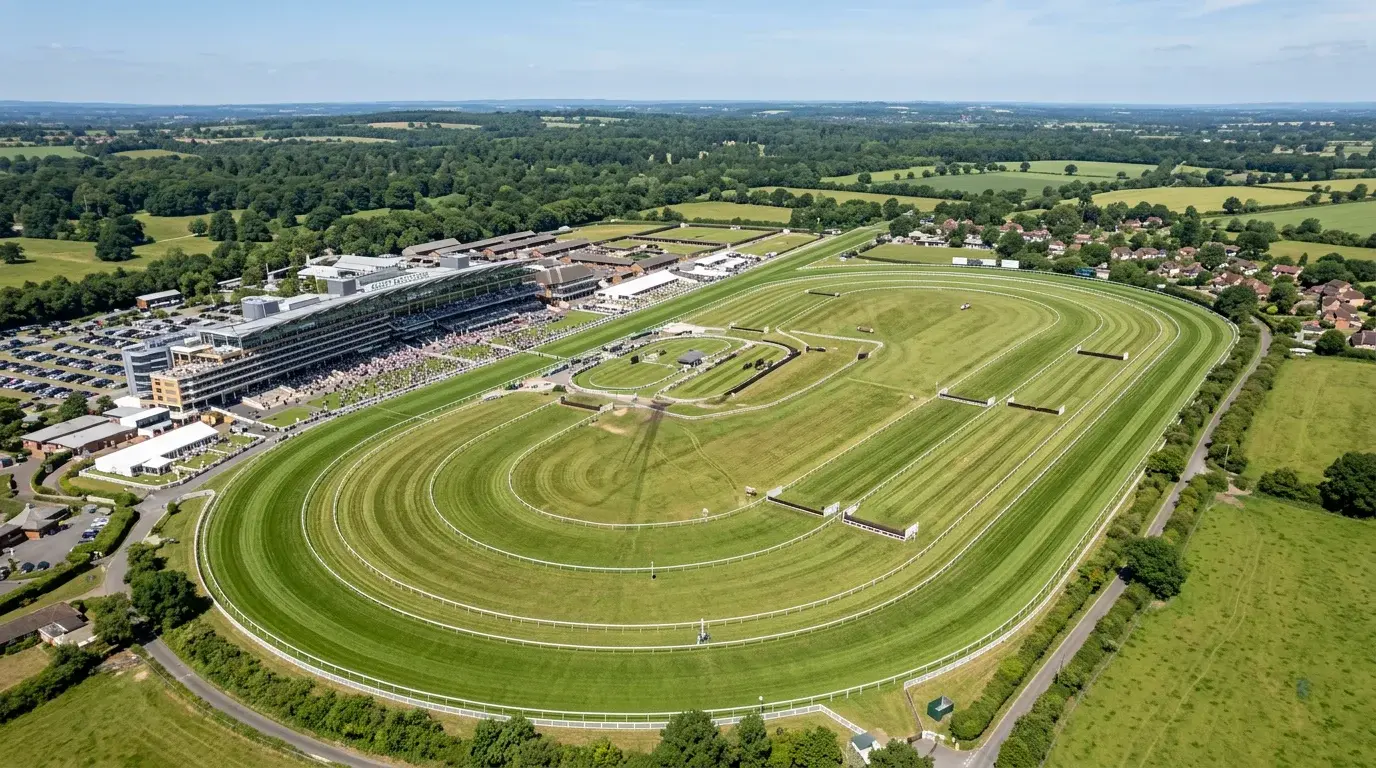
Britain has 59 active racecourses, and the assumption that they are interchangeable is one of the most common errors in horse racing betting. Each track has its own character — its gradient, its camber, its drainage, its prevailing wind pattern, its draw bias, and its unique relationship between surface and going. A horse that dominates at flat, fast Newmarket might flounder at undulating Goodwood. A chaser that jumps Cheltenham’s hill with ease might not handle the sharp bends at Plumpton. Track knowledge is not a luxury in horse racing betting; it is foundational.
Of those 59 courses, 19 are flat-only, 24 are dedicated to jump racing, and 16 are dual-purpose venues that host both codes. Total racecourse attendance reached 5.031 million in 2025 — the first time the figure exceeded 5 million since 2019 — demonstrating that the in-person racing experience remains a significant draw despite the migration of betting online.
Racecourse Classifications: Differentiating Flat and Jump Track Dynamics
The flat-only courses range from historic championship venues to workmanlike all-weather tracks. Newmarket, with its Rowley Mile and July Course, is the headquarters of British flat racing and hosts more Group 1 races than any other UK venue. Ascot is the most prestigious, home to the Royal Meeting in June. Epsom exists for one weekend a year when it matters — the Derby and the Oaks — and its unique camber and gradient make it unlike any other track in the world. The all-weather flat tracks — Lingfield, Kempton, Wolverhampton, Newcastle, Chelmsford, and Southwell — provide year-round racing on artificial surfaces, serving as the sport’s winter backbone.
Jump-only venues are concentrated in the rural heartlands. Cheltenham is the sport’s spiritual home, with its amphitheatre layout and its annual festival that attracts record television audiences. Aintree hosts the Grand National but also runs a full programme of high-class jump racing throughout the winter. Smaller venues like Towcester, Fontwell, and Fakenham offer lower-tier jumping but are often the places where future stars begin their careers — and where the betting markets are thinnest and most susceptible to mispricing.
Dual-purpose courses offer the greatest variety. Sandown runs high-quality flat and jump racing across both seasons. Haydock is a premier venue for both codes, with its deep ground in winter making it a test of stamina over jumps and its flat course producing competitive sprint handicaps in summer. York, Doncaster, and Newbury are all dual-purpose tracks that host major fixtures on both sides of the calendar.
Average attendance at Premier Fixtures grew by 5.3% in 2025, with Core Fixtures also up 4.4%. This growth was concentrated at the bigger venues, where investment in facilities and prize money attracts both racegoers and higher-quality fields — a pattern that has direct implications for bettors, because the best betting markets are found where the best horses run.
Track Shape, Direction and Surface: What Matters for Betting
Track shape is the single most important course characteristic for betting purposes, and it is the one most beginners ignore. British courses come in several configurations: oval circuits (left-handed and right-handed), figure-of-eight layouts, straight courses, and irregular shapes with pronounced undulations. Each configuration favours a different type of horse.
Left-handed tracks — Ascot, Cheltenham, Haydock, Newbury, York — require horses to turn predominantly to the left. Right-handed tracks — Sandown, Kempton, Doncaster, Goodwood — go the other way. Some horses have a strong directional preference, particularly over jumps where the angle of approach to an obstacle changes with direction. A chaser that jumps fluently left-handed might be awkward and lose ground right-handed, and this preference is consistent enough to be a genuine form factor.
Sharp tracks versus galloping tracks is the other critical distinction. A sharp track has tight bends and a short straight, favouring nippy, handy horses that can accelerate quickly out of turns. Chelmsford, Chester, and Fontwell are sharp. A galloping track has sweeping bends and a long run-in, favouring horses that stride out and build momentum. Newmarket, York, and Newbury are galloping tracks. A horse that has won twice at Chester and nowhere else is not a bad horse — it is a Chester horse, and backing it at York is a different proposition entirely.
Surface matters beyond the flat/jump and turf/all-weather splits. The drainage at each course determines how quickly the going changes after rain. Sandy-soil courses like Newmarket drain quickly and rarely ride worse than good to soft. Clay-based courses like Lingfield’s turf track or Plumpton hold water and can turn heavy after moderate rainfall. Knowing which courses drain and which do not gives you a head start on assessing the going before the official readings are published.
Signature Meetings: Where the Best Racing Happens
Every course has its flagship meeting — the card or festival that attracts the best horses, the biggest fields, and the deepest betting markets. These are the days when the form book is richest, the competitive quality is highest, and the betting opportunities are most genuine.
The big five festivals dominate the calendar: Cheltenham in March (four days, the pinnacle of jump racing), the Guineas Festival at Newmarket in May (the first classics of the flat season), the Epsom Derby meeting in June, Royal Ascot in June (five days, flat racing’s showcase), and Glorious Goodwood in late July/early August (five days of high-quality flat racing on a unique downland track). Each festival produces multiple Grade 1 or Group 1 races and typically fills the racecards with Premier-level field sizes averaging 11.02 runners on the flat.
Beyond the festivals, individual feature days at venues like York (the Ebor meeting in August), Doncaster (the St Leger meeting in September), and Aintree (the Grand National meeting in April) offer high-quality racing with substantial betting markets. Saturday cards at Newbury, Haydock, and Sandown throughout both seasons are the week-to-week backbone of serious racing and serious betting.
The practical takeaway for bettors is that not all racecards are created equal. A seven-race card at Catterick on a Monday afternoon attracts smaller fields, lower-quality horses, and thinner betting markets than a Saturday card at Newbury. The information edge that form study provides is larger in better races with more runners, more data, and more public money in the market creating genuine price discovery. Concentrating your betting on feature days and flagship meetings is not snobbery — it is efficiency.