

If you have never placed a bet on horse racing before, you are in good company. Around 68% of people who attend British racecourses in any given year are casual or first-time visitors, and a significant proportion of them are navigating the betting process for the first time. The sport has been running for centuries but the mechanics of actually placing a bet — from opening an account to reading odds to understanding what happens when your horse finishes second — are rarely explained in a way that assumes you genuinely know nothing. This guide assumes exactly that.
I remember my own first bet. I picked a horse because I liked the name, staked £5 because it seemed like a reasonable amount to lose, and watched it finish seventh of twelve with absolutely no idea whether that was a good run or a disaster. What I lacked was not enthusiasm but process. This walkthrough gives you the process, step by step, so that your first bet is informed even if the outcome is uncertain.
Once you understand the basic bet types, your next crucial skill will be reading a horse racing form guide to evaluate past performances.
Reading Odds for the First Time: What the Numbers Mean
Odds tell you two things: how likely the bookmaker thinks a horse is to win, and how much you will be paid if it does. In the UK, odds are traditionally shown as fractions — 5/1, 3/1, 7/2, 11/4. The first number is what you win; the second is what you stake. At 5/1, a £1 bet returns £5 in profit plus your £1 stake back, totalling £6. At 3/1, the same £1 returns £3 profit plus the stake, totalling £4.
Odds shorter than evens — like 4/5, 8/11, or 1/3 — mean the horse is expected to win more often than it loses. These are called odds-on. At 4/5, you stake £5 to win £4 profit. The shorter the odds, the more likely the bookmaker thinks the horse is to win, but the less you get paid. The longest-priced horse in a race — the rank outsider — might be 50/1 or 100/1. Those horses rarely win, but when they do, the payout is enormous.
If fractions confuse you, switch your bookmaker’s display to decimal odds. The same prices become simpler: 5/1 = 6.0, 3/1 = 4.0, 7/2 = 4.5. The decimal number is your total return per pound staked, including the stake itself. A £1 bet at 6.0 returns £6. A £1 bet at 4.0 returns £4. Most betting apps let you toggle between fractional and decimal in the settings. For a deeper exploration of how odds work across formats, the full odds guide covers the mechanics in detail.
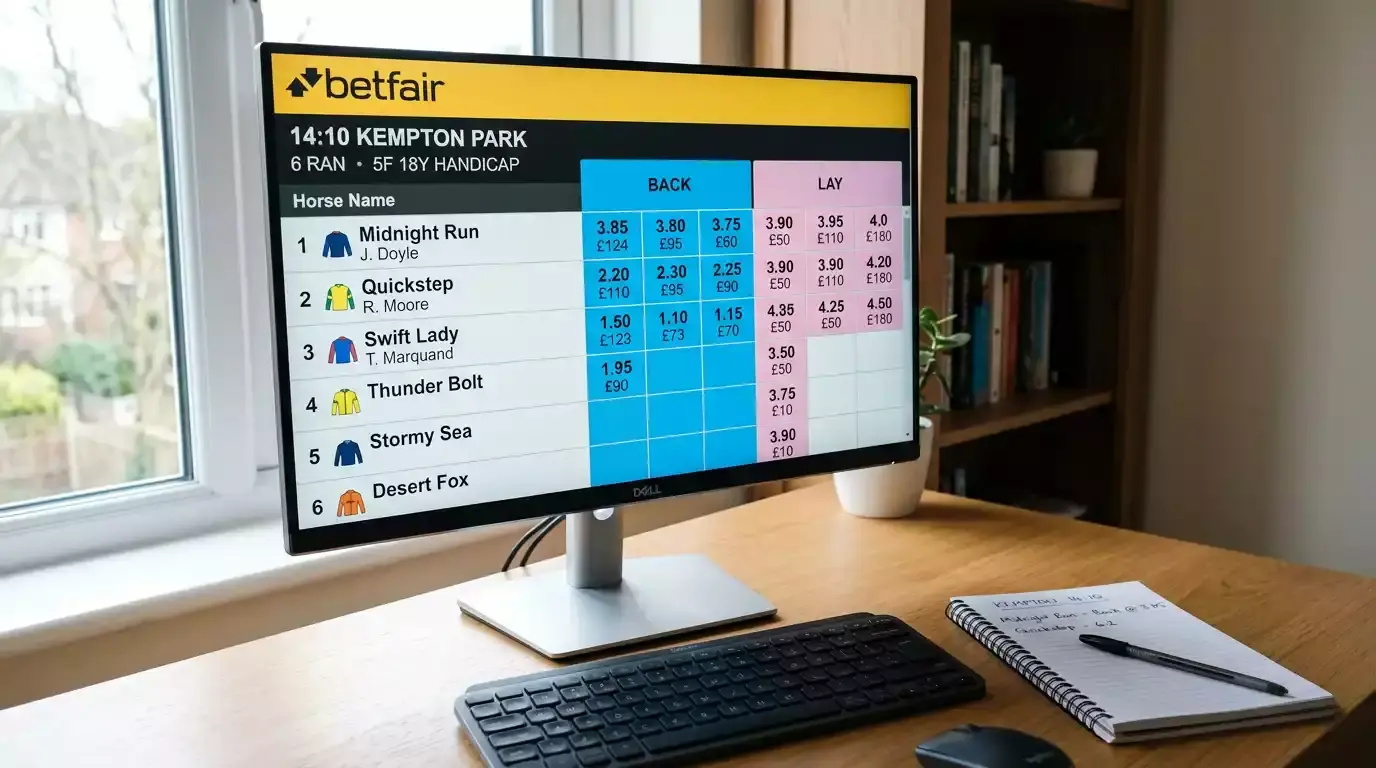
One thing that catches beginners: odds change before a race. The price you see on Monday might not be the price available on Saturday. Odds shorten when money comes in for a horse and drift when money goes elsewhere. The price you actually get is the price displayed when you confirm the bet — unless the bookmaker offers Best Odds Guaranteed, which pays the higher of your taken price or the Starting Price if it is bigger.
Placing Your First Bet: A Click-by-Click Walkthrough
Open your bookmaker’s app or website and navigate to horse racing. You will see today’s meetings listed by racecourse — Ascot, Cheltenham, Newmarket, whatever is running. Tap a meeting to see the day’s races, listed by time. Tap a race to see the racecard: a list of every horse running, its jockey, trainer, recent form, and current odds.
Choose a horse. For your first bet, pick one that is neither the favourite nor the rank outsider — something in the 5/1 to 10/1 range gives you a reasonable chance of a return without the odds being so short that the payout is barely worth celebrating. Tap the odds next to the horse’s name. This adds the selection to your bet slip, which usually appears at the bottom of the screen.
In the bet slip, you will see your selection, the current odds, and a box to enter your stake. Type in the amount you want to bet — £2, £5, whatever feels comfortable. The slip will show your potential return if the horse wins. Check the details: right horse, right race, right stake. Then tap “Place Bet” to confirm.
You now have a live bet. If the race has not started yet, your bet is queued. Once the race begins, you can watch it live on most betting apps if your account is funded. When the race finishes, the result is usually confirmed within a few minutes — sometimes longer if there is a photo finish or a stewards’ enquiry. If your horse wins, the winnings are credited to your account automatically. If it loses, the stake is deducted and that is that.
A common first-timer question: should you bet each-way? An each-way bet is two bets in one — a win bet and a place bet. If your horse wins, both parts pay out. If it finishes in the places (usually second or third in smaller fields, second through fourth in fields of 16+), the place part pays at a fraction of the win odds, typically 1/4 or 1/5. Each-way costs double the unit stake — a £5 each-way is £10 total — but it gives you a return even when your horse does not win. For beginners backing mid-range prices in competitive races, each-way is a sensible starting point.
Start your wagering journey safely by choosing from our curated list of reliable UK betting sites for racing.